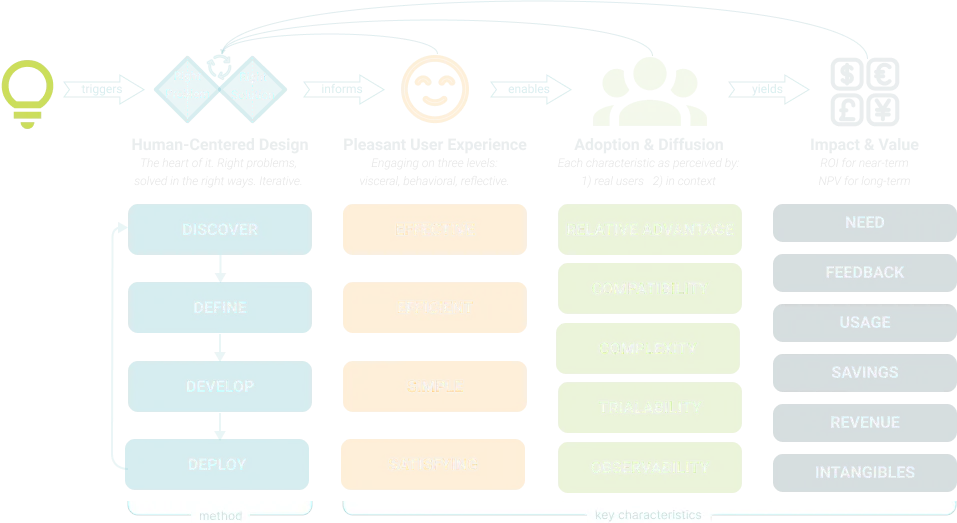
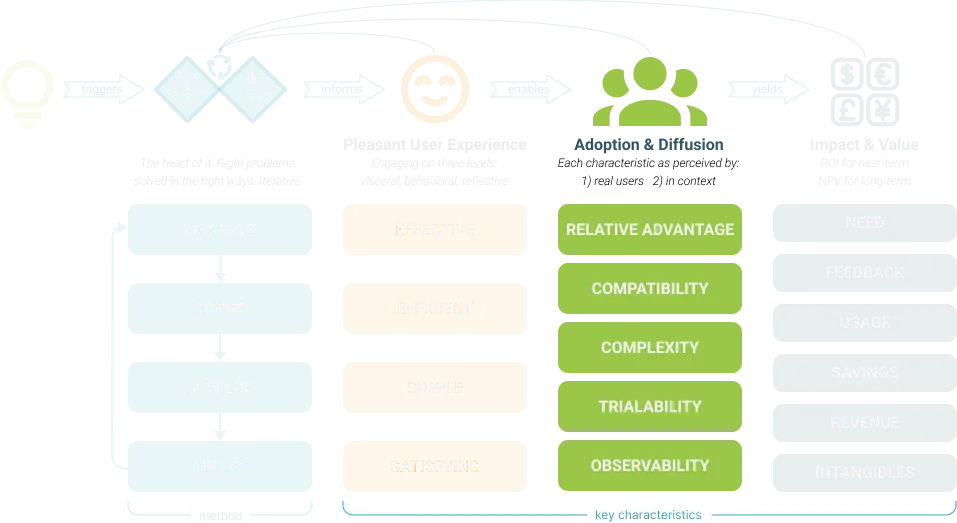
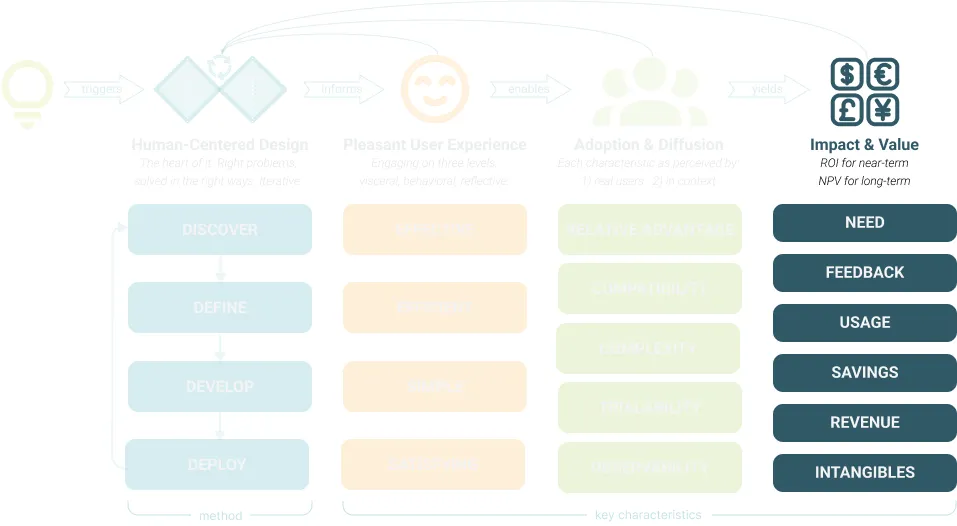
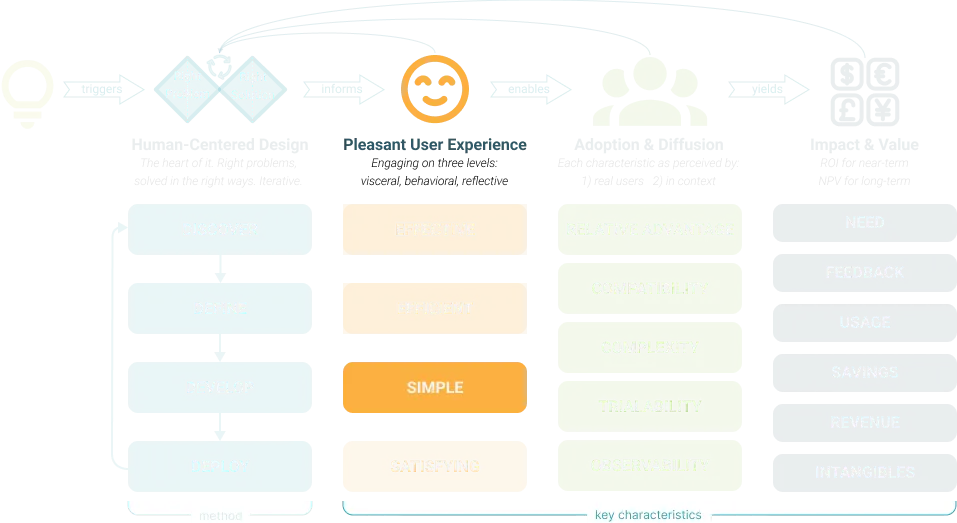
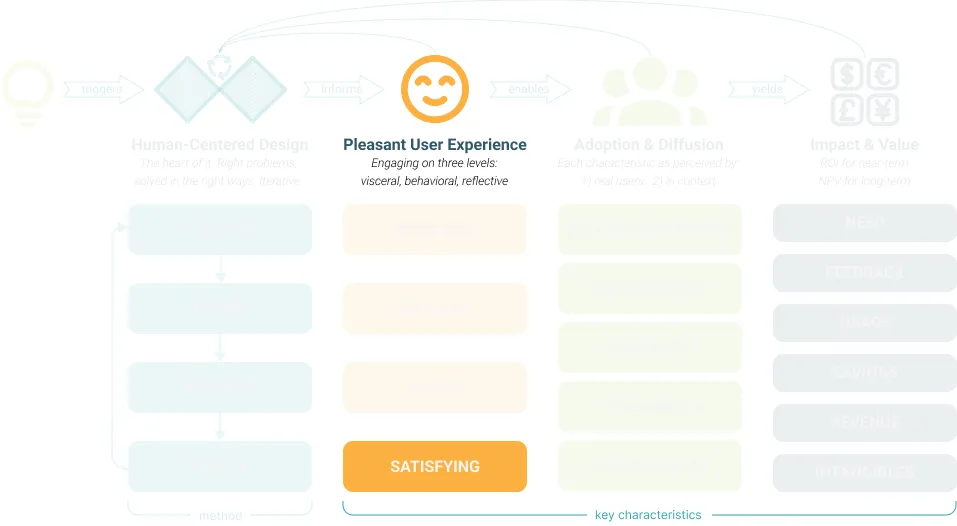
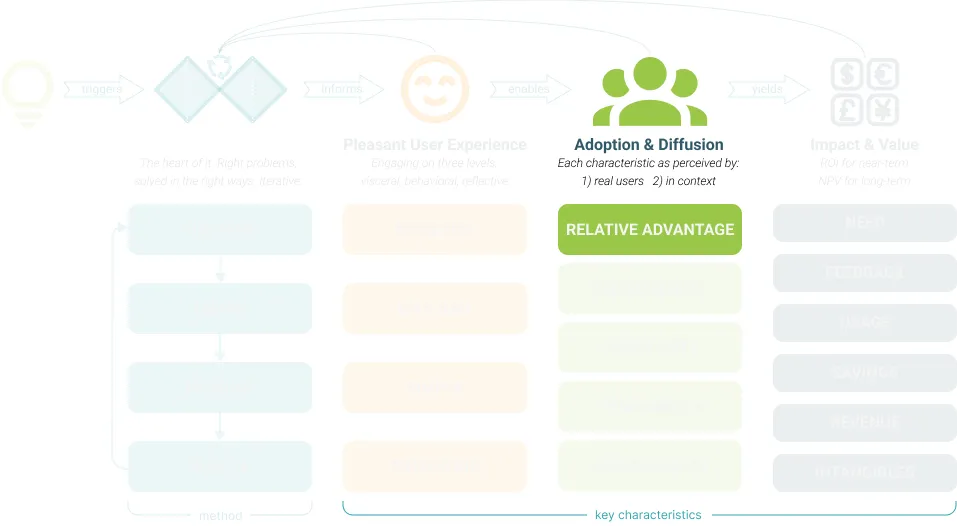
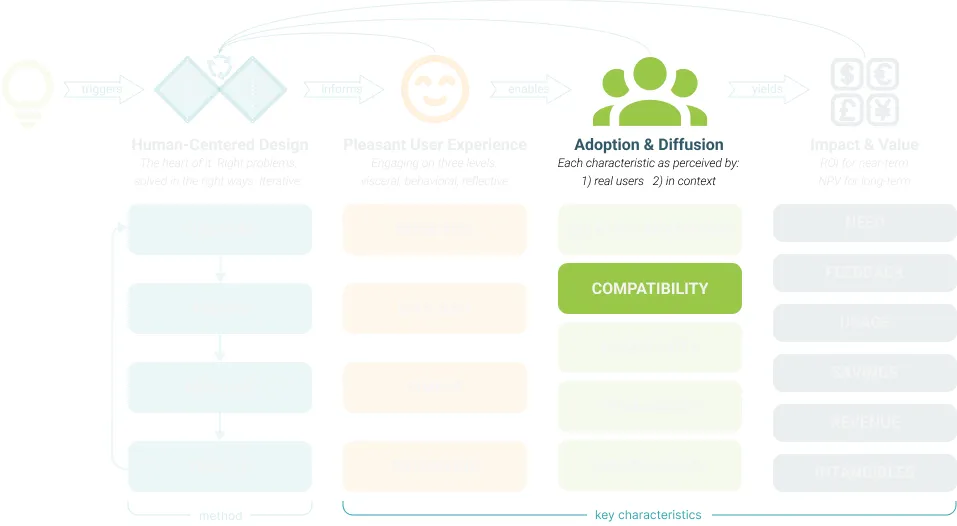
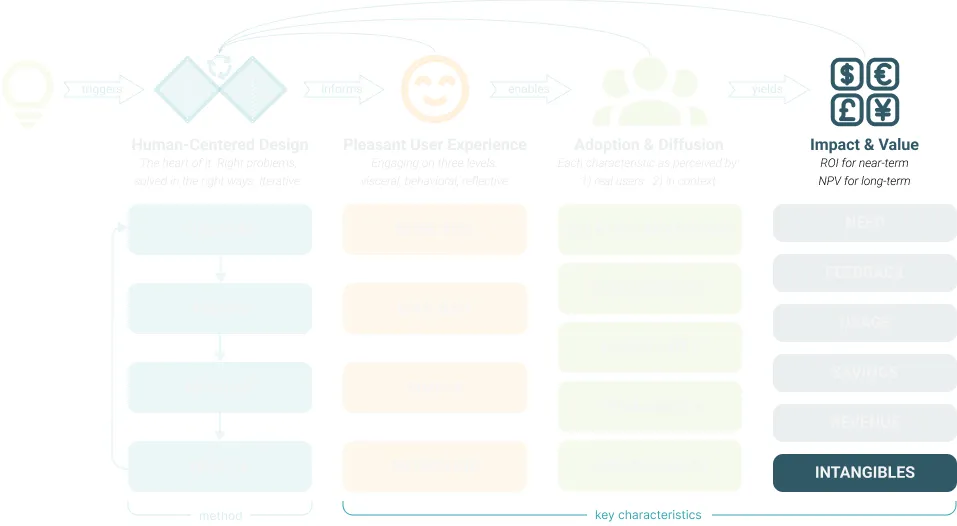
Ideas can originate at the ground level and be driven up through an enterprise, or they can be driven top-down by a company’s leaders.
Top-down ideas have the benefit of leader-backing, budget for resources, and the leader’s influence. However, leadership changes can put top-down ideas at risk, making quick progress and proof essential.
Bottom-up ideas have the benefit of originating from real problems rather than leader perceptions of them. However, bottom-up ideas must be proven – often with little budget and as a “side gig” to an innovator's “real job” - to gain leader buy-in and authorization. To do this, tactics of stealth or shoestring innovation must be used, practices like proving concepts as intern projects or generating pull from real users through high fidelity interactive mockups. As stealth innovation costs companies little, innovation using these tactics tend to have more time for iterative human-centered design.
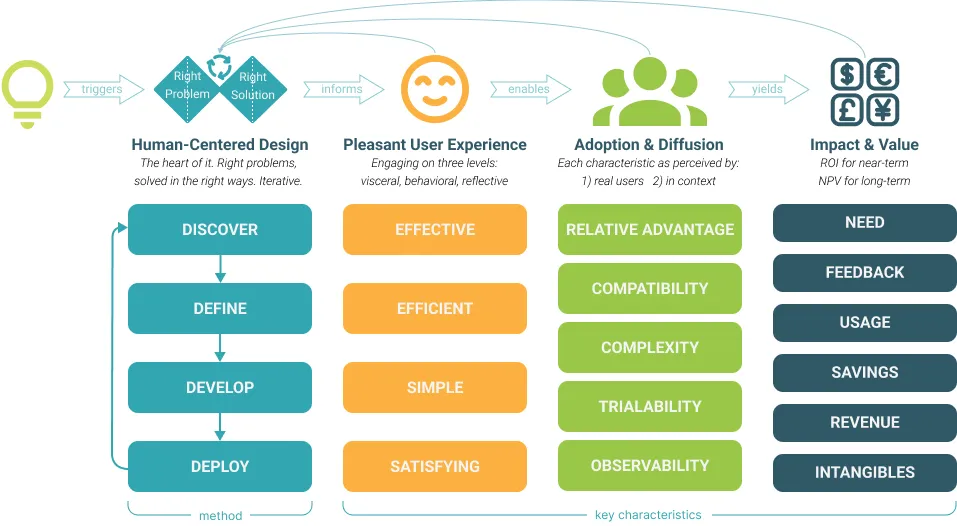
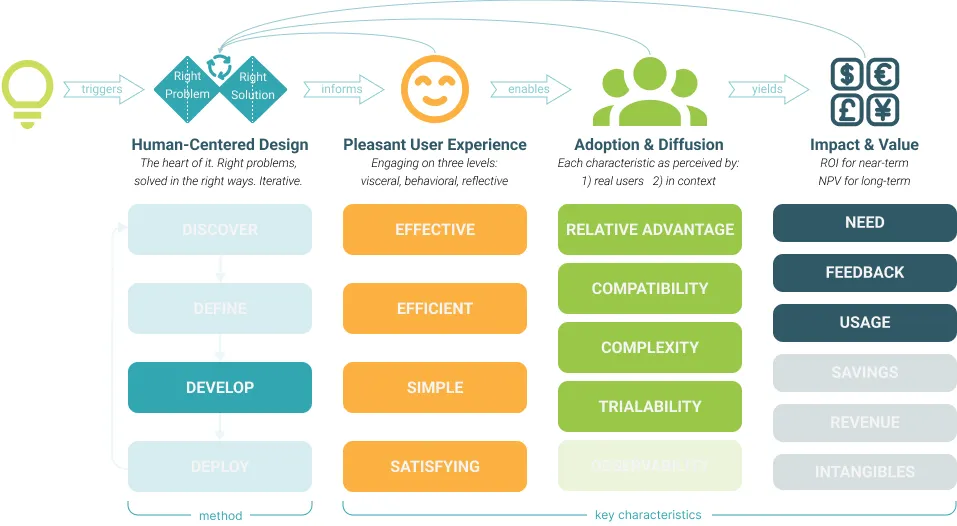
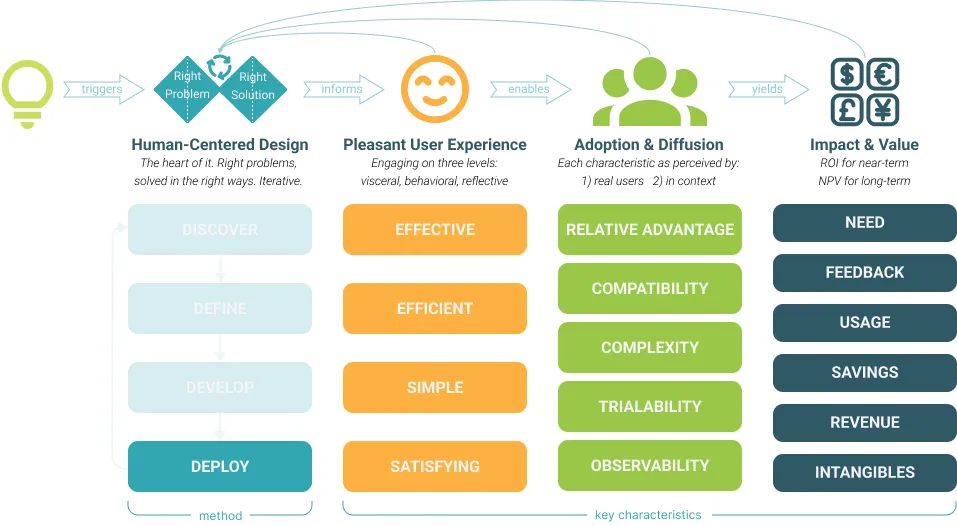
Most every impactful innovation uses Human-Centered Design, HCD. HCD helps inform what users will perceive as a pleasant User Experience, UX.
Good UX enables but does not promise user adoption and then broad, organic diffusion. It is only through adoption and diffusion that an innovation yields impact & value.
Start by clicking along the top of the framework, from Idea to Impact, to learn about each category. Click anywhere behind the framework to go back to the home screen.
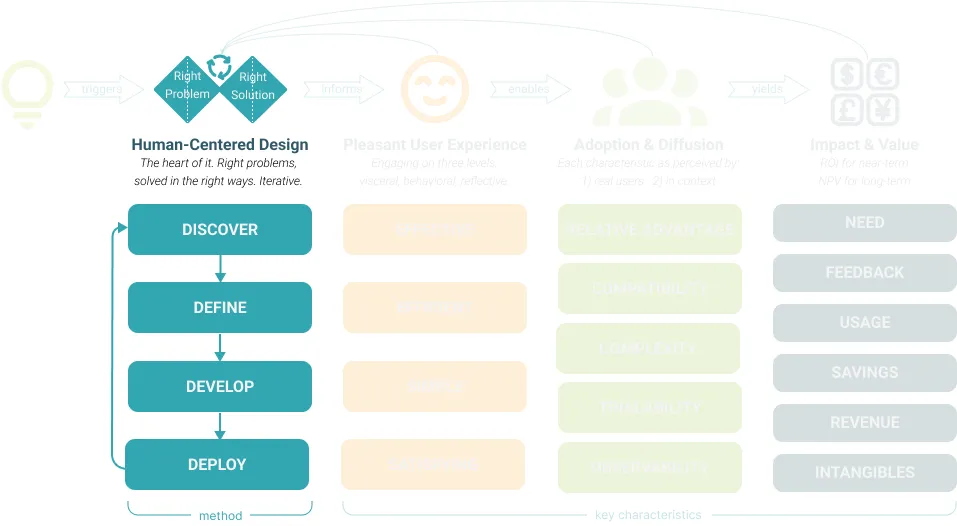
Next, click each step in the HCD method, from Discover to Deploy, to see when different key characteristics become relevant throughout the design process.
Finally, click any key characteristic to learn about the attributes that make it successful for people.
Human-Centered Design, HCD, is the heart of most every impactful innovation effort, and the most important part of HCD is understanding the right problem. Why? As the design great Don Norman said, “Invariably the problem I am asked to solve is not the real, fundamental problem.”
Only by knowing the right problem can you design the right solution. Understanding the right problem is the first phase of HCD, and it happens in two steps: Discover & Define.
Using the British Design Consortium’s “double diamond” visualization, in Discovery you’re opening your perspective – the diamond’s left – observing and questioning everything. In the diamond’s right side, Define, you’re synthesizing and narrowing-in on the right problem.
The second diamond, designing the right solution, again starts with an opening of view. Develop is toward considering the many ways the right problem might be solved. Considering UX and user perceptions, though, the right side of the second diamond, Deploy, is toward selecting or designing the right solution from among the options.
Important: HCD is iterative. This is why HCD often succeeds when assuming requirement-based approaches fail. There’s much that’s unknown – always – but HCD encourages iteration as unknowns become known.
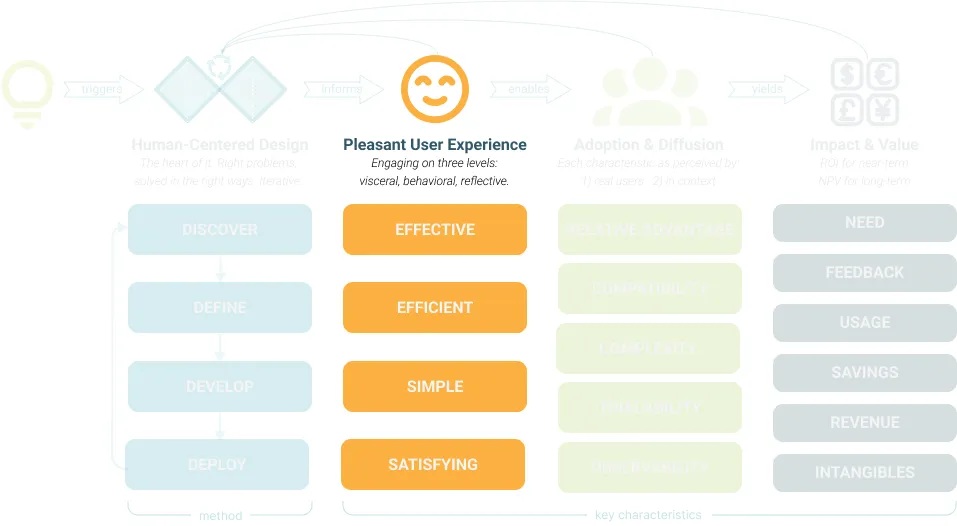
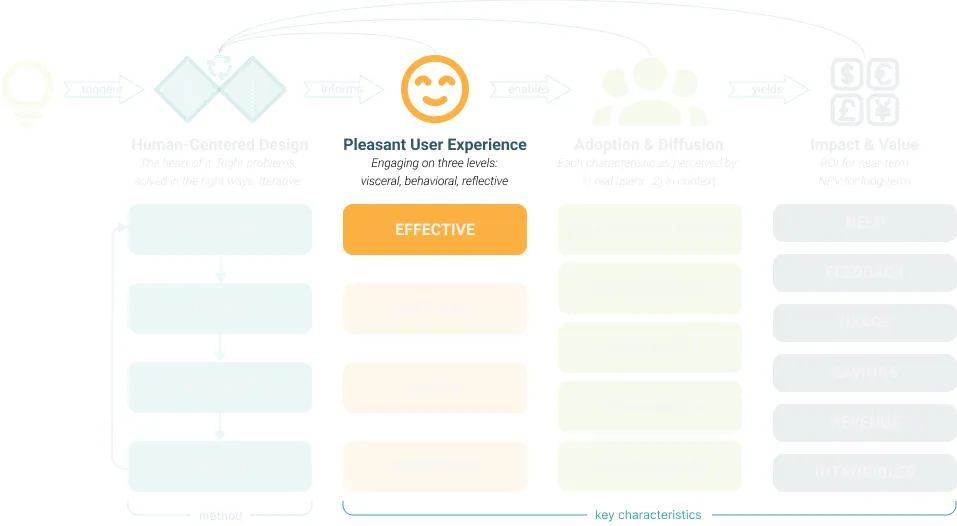
User experience, UX, is more than the user interface, UI. UX encompasses all aspects of a user’s – yup – experience of a solution, from how they find it to their support experience and even their social experiences as a user away from the app.
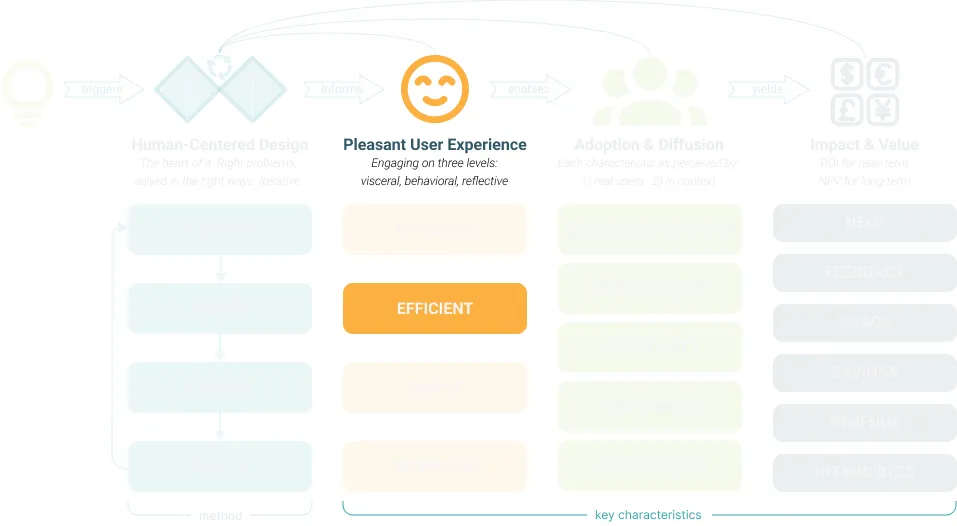
A pleasant UX happens in many ways, though the most common are the experiences of a solution that’s effective (recall the most important part of HCD, solve the right problem!), efficient, simple, and satisfying.
The user’s experience of these plays across three engagement levels: visceral, behavioral, and reflective.
Visceral engagement is the first and most important to near-term adoption: It’s the first impression, the kneejerk reaction to an innovation. Is it cluttered or inviting? Is it visual or wordy? First impressions are as important in design as they are in interviewing or dating.
Behavioral is the user’s experience of the innovation beyond that first impression, as they use it. Extending the dating metaphor, it’s whether on subsequent dates the person is sometimes a jerk to the server, whether their car or home is a mess, or whether they can get angry too easily.
Reflective is the last and most important engagement, both for long-term adoption and the organic diffusion of an innovation. Reflective engagement is the extent to which, for instance, the user is so impressed with an innovation that they talk about it on a date. UX that’s so pleasant that the user discusses it with others is needed for the peer-to-peer, network-to-network, site-to-site, and nation-to-nation diffusion of innovations.
As introduced in the book Diffusion of Innovations and proven through thousands of case studies, there are five key characteristics driving an innovation’s adoption and then diffusion: Relative Advantage, Compatibility, Complexity, Trialability, and Observability. Each is as perceived by 1) real users and 2) in the context of their real and perceived needs.
Relative Advantage: How does the user perceive the innovation compared to their overall experience, UX, of alternatives including doing nothing?
Compatibility: How compatible is the innovation with the user’s past experiences, cultural norms, biases and preferences, and so forth?
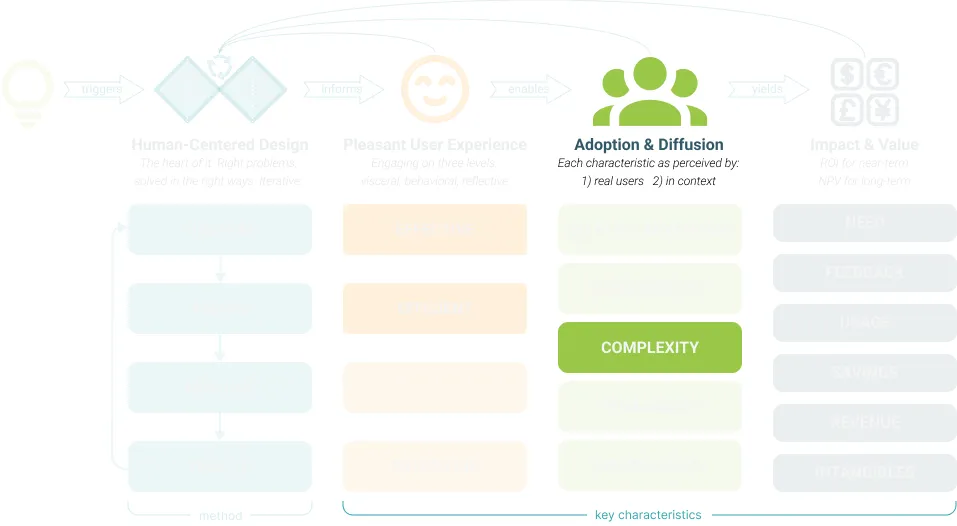
Complexity: How hard is it to use, give feedback on, get support for, etc.?
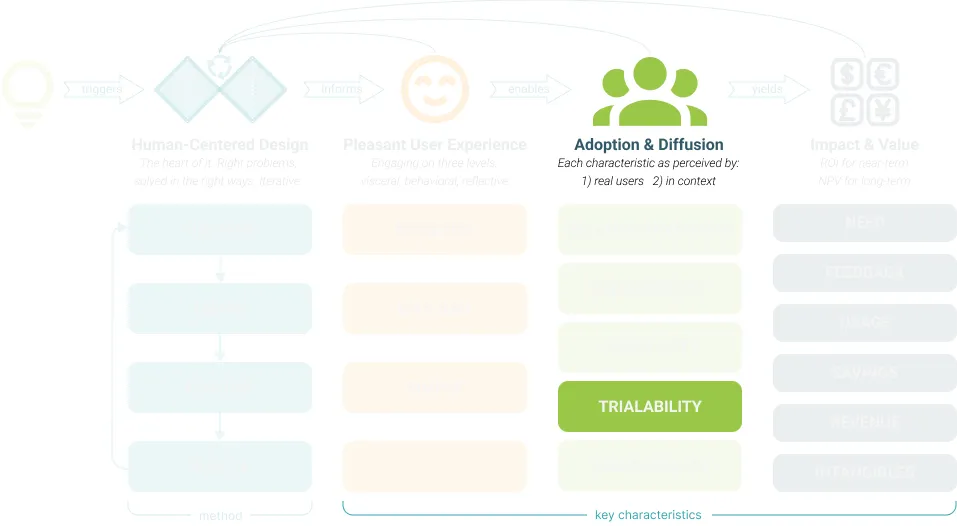
Trialability: How easy is it to give the innovation a try? Is specialized equipment needed? Does it need an expert to explain its use? How hard is licensing?
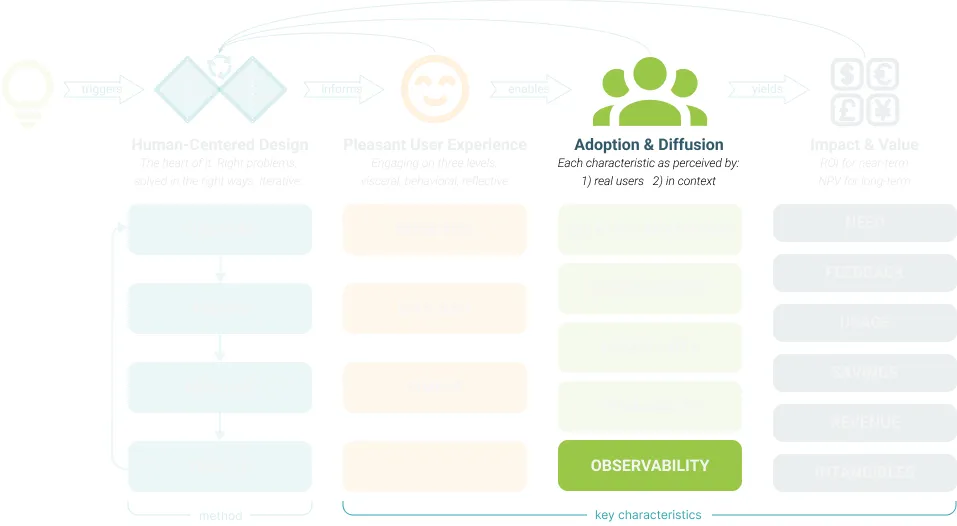
Observability: When using or walking past someone using the innovation, how easy is it to see its benefits to the user? Its benefits to the enterprise matter less than user benefits, because users are who adopt, while mandates seldom last.
Too often the impact of innovations is only considered in terms of Return on Investment, ROI. This is short-sighted, as there are others of equal importance.
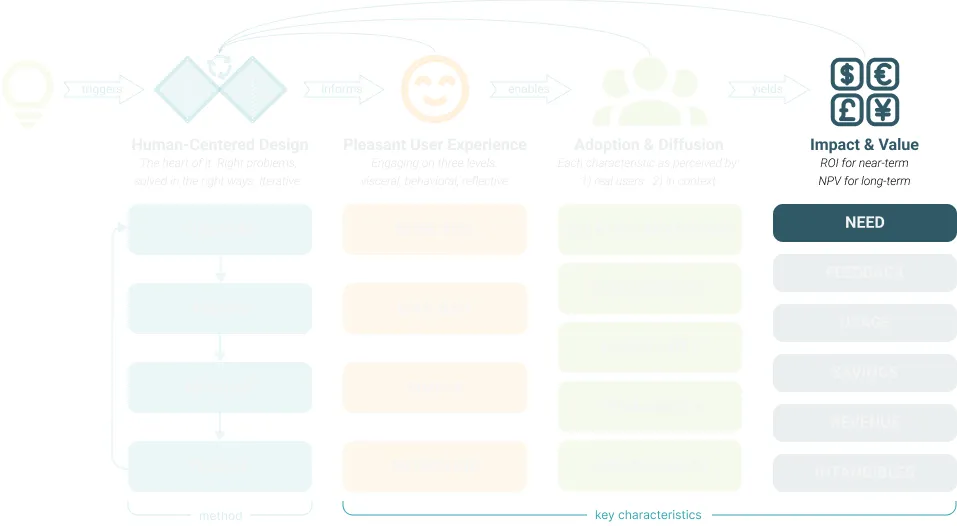
Need: Now that you’ve found the right problem to solve (Human-Centered Design), is this a niche problem in the enterprise or one that impacts many products or sites?
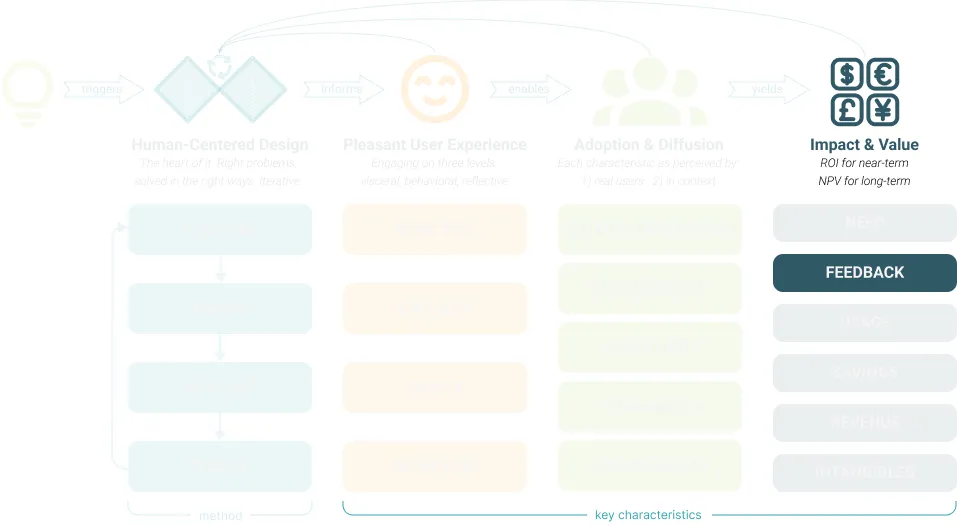
Feedback: Some of the earliest signals of benefit is user feedback. These leading indicators help you discover what to measure for quantified benefits, and they address cynics of the numbers that will come later.
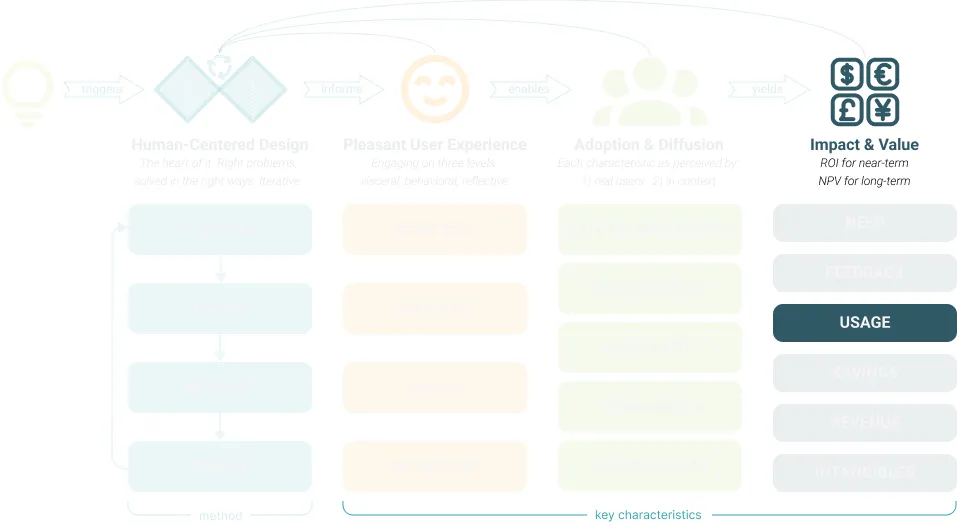
Usage: Never launch an innovation without means to measure usage. Before ROI can be calculated, your first indicator of impact (or not) is usage growth (or decline). In either case, engage with users to understand why they’re bragging on the innovation (or turning away).
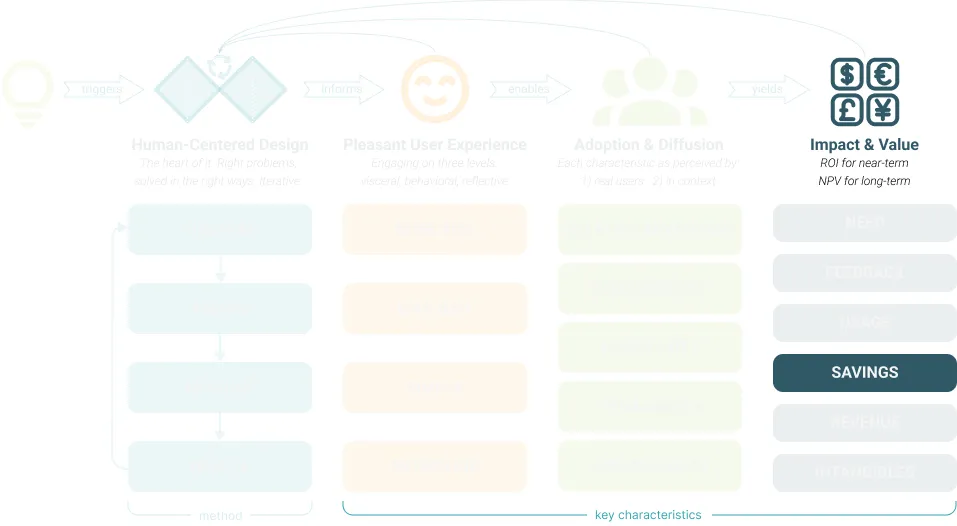
Savings: Finally we reach ROI. ROI, though, is only for near-term benefit, usually a time horizon of 2 to 3 years. Because the value of a dollar changes with time, and because impactful innovations can have long staying power, use Net Present Value (NPV) to calculate benefits over longer time horizons.
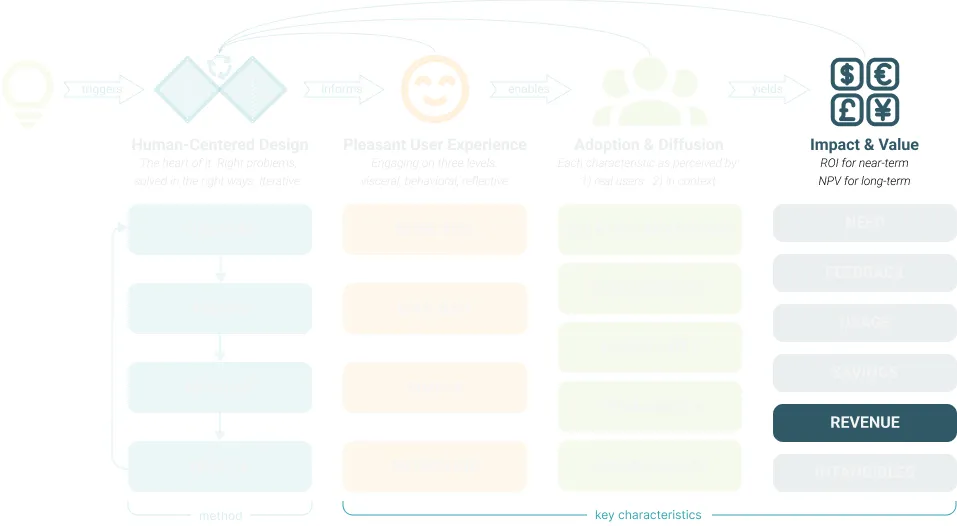
Revenue: If the innovation is to be used as a revenue stream, that factors here. Less obvious forms of revenue-like value are increased contract capture or increased intellectual property portfolios, for instance when AR is used to capture and codify tribal knowledge.
Intangibles: While it’s hard to put a price on increased goodwill in the marketplace, better brand value for an enterprise, and improved employee engagement and perception of their company, such intangibles catalyze for enterprise success.
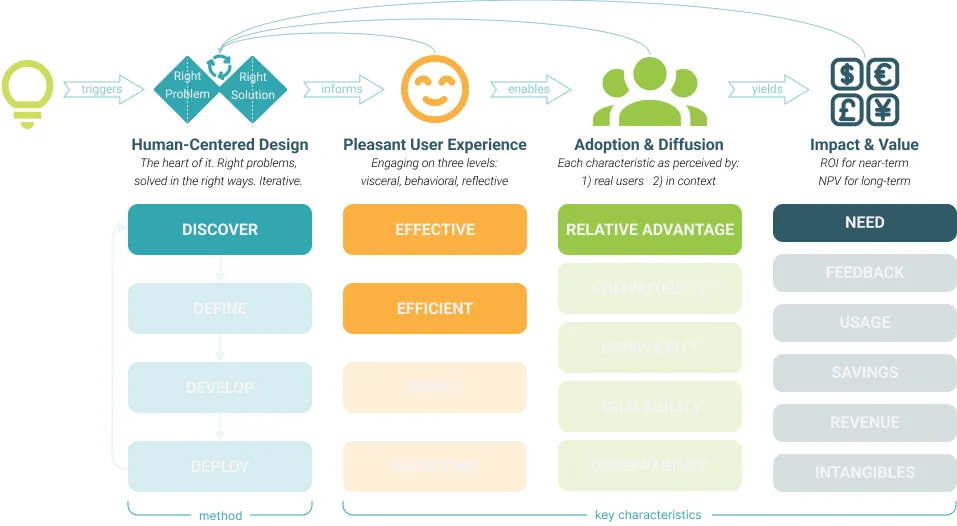
The goal of the discovery phase is to observe and understand real users as much as possible. The best understood problems make for the best designed solutions. It's through understanding user needs, environments, culture, and other realities that impactful solutions materialize.
Pleasant UX isn’t a focus during discovery, because the innovator’s focus is on understanding problems, not ideating solutions. However, understanding problems means discovering what is and isn’t working for users (EFFECTIVE), what is and isn’t taking time (EFFICIENT), and why.
Adoption & Diffusion likewise isn’t a focus in discovery, though the innovator is coming to understand the existing preferred methods and what an innovation must do to augment or even displace them (RELATIVE ADVANTAGE).
Impact & Value is focused on NEED during discovery. How widespread is this problem? When it happens, how costly is it? Prioritize wide-spread, high-cost problems. Wide-spread, low-cost problems also deserve priority, as modest help on a large scale is often more impactful than bigger though localized benefits.
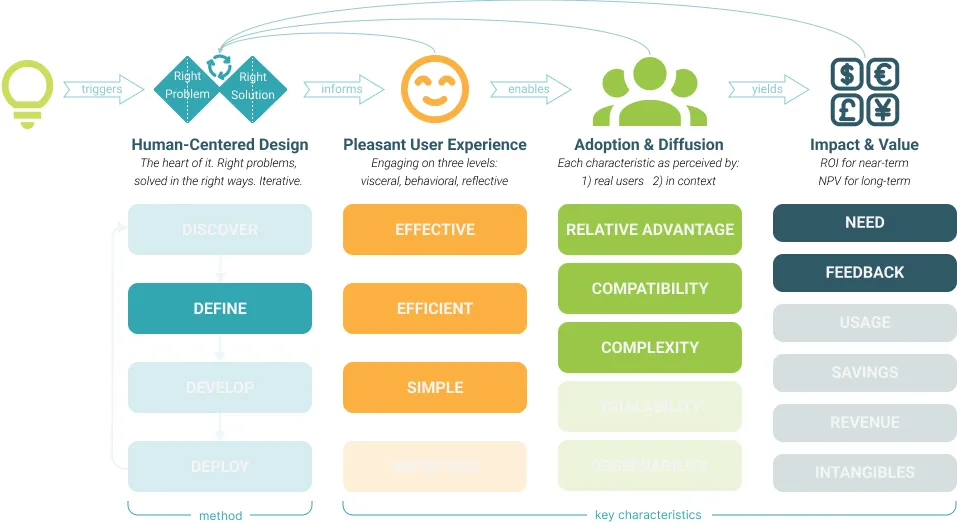
While the DISCOVER phase of HCD dealt with opening yourself to learning as much about user realities as possible, the DEFINE phase is about narrowing-in and distilling it down to the core problems and user needs.
During DISCOVERY for an AR innovation you might have observed that when Operators assemble their product, simple steps like installing screws and subassemblies were fast and reliable. However, you noticed that with complex cable harnesses, it took longer, were more error-prone, and people used printed instructions because it was difficult to keep the cable routings and anchor points in memory. So, the problem in this scenario isn’t that people need AR for ALL work instructions, only the spatially complex ones.
Pleasant UX in the DEFINE stage expands as you begin to understand user needs for what will qualify as SIMPLE for them. What they’ll perceive as more EFFECTIVE and EFFICIENT will also become clearer.
Adoption & Diffusion will expand to include COMPATIBILITY and COMPLEXITY as you isolate the core problem(s) needing solved and how they relate to user needs. COMPATIBILITY is often overlooked in innovation, but you can click its block to learn more.
Impact & Value grows to include FEEDBACK, as users will begin to voice excitement in your isolating their greatest needs and even mocking up how it might be different. In fact, unsolicited enthusiastic feedback is a key indicator that you’re on the right path. Polite acceptance is a glaring red flag.
The DEVELOP step in HCD is the fun one. It’s the Siren call of innovation. It’s where innovators too often start, skipping the first diamond of understanding the right problem, thus pursuing the wrong solution or a solution that works in the wrong way for users.
Extending the AR innovation scenario discussed in DEFINE, during DEVELOP you might partner with an AR company who can integrate with your enterprise systems, develop augmented instructions quickly, and deploy on a variety of devices to trial with users. Your goal would be to “dabble” with many different approaches as fast and affordably as possible. If your user community wasn’t very tech savvy, you might opt to pilot with a tablet-based AR solution and wait to introduce smart glasses until the pilot proves successful.
Pleasant UX comes into full view in the DEVELOP step. You’re assessing people’s perceptions of how EFFECTIVE, EFFICIENT, and SIMPLE different approaches are. And for the first time users get a sense of how SATISFYING a solution is to use.
Adoption & Diffusion grows to include TRIALABILITY. For instance, are a lot of approvals needed for a device to be used. RELATIVE ADVANTAGE, the most important attribute in adoption and diffusion, crystalizes given real solutions to compare to existing methods.
Impact & Value now includes USAGE as piloting begins, which means including usage analytics in the design – an absolute must. Whichever direction usage trends, analytics empower you to know by how much and which questions to ask of users.
HCD is iterative by design, because practically no innovation gets things right on the first try. That’s especially true in DEPLOY. Development often happens at least three times before Go Live: Proof-of-Concept to prove one-time feasibility, Pilot to prove and discover needs for broader viability, and Beta toward discovery and dev for full enterprise scalability.
In DEPLOY, the full Innovation Impact Framework is fleshed out. And the focus shifts to responsive bug fixes and value harvesting, both in terms of quantitative value via integrated analytics, and qualitative user stories and quotes. Innovators and leaders need both.
Pleasant UX by now should be known. Sources of friction that remain deserve prompt attention with gratitude expressed publicly and sincerely for folks who brought problems or further ideas forward. UX is the whole experience of an innovation, and recognition is part of that experience.
Adoption & Diffusion becomes a focus with analytics quantifying both usage and impacts to processes or other user experiences. Though OBSERVABILITY is as perceived by users, and high OBSERVABILITY paired with strong outcomes in the other four adoption attributes fuels viral organic diffusion.
Impact & Value is another priority during DEPLOY. Leaders understand that big impacts grow from small efforts, but before they promise the funds to go big, they need to know that this former seed of an idea is working for users and adding value as a seedling (pilot) and then as a sapling (beta). If it was your money (and it is), you’d have the same need to know.
Users perceive an innovation as effective when:
Its feature set is relevant. This means that key features exist, while niche ones are either excluded or exist without adding controls, words, or other complications to the interface.
It is correct. Of course this applies to the correctness of data, including how quickly revisions to things like enterprise models reflect in an AR solution. It also applies to aspects like how well augmentations align with and occlude behind nearer objects.
It’s clear, unambiguous. This is the extent to which it’s “glanceably self-evident” what something means. For instance, it’s slow to read words, they’re rife with chances for misunderstanding, and they pose language barriers.
It’s timely, available. The extent to which an AR solution anticipates a user’s needs and “seems to know what I need”, the more effective it is perceived. For instance, if computer vision can see that an assembly step is complete and auto-advances to the next step rather than the user needing to ask, pinch, or click to proceed.
It helps users attain THEIR goals. A common mistake in enterprise innovation is assuming that employee and company goals align. Though often they do, users always have personal goals, for instance feeling respected and valued.
We experience an innovation as efficient when it has a fast:
Initial setup time. This includes the time it takes to install, license, and learn. A challenge of enterprise AR innovation is that these need done for both the device and the software.
Daily startup time. Reducing or removing friction from login/authentication, navigating directories, opening apps, loading files, etc. helps.
Interaction response time. Not only is this how long it takes the innovation to respond to a user interaction, it’s also how many attempts it takes to register a voice command, a gesture, pressing the correct button somewhere on the headset or glasses, etc.
Comprehension time. Once the innovation responds, comprehension or sensemaking time is how long it takes to accurately understand the response. Visualization is best, as an entire scene is comprehended in half the time it takes to read a single word.
Support response time. This includes the time it takes to discover and request support, as well as for support to be given. Make feedback mechanisms easy to find, and whenever possible follow-up with users in person and within an hour. (It’s what you’d appreciate, too.)
We experience an innovation as simple when it:
Uses familiar conventions, mental models. Familiarity eases learning and use. For instance, since interactive objects (buttons, links, images) change appearance when hovered in web and Desktop apps, make interactive objects glow or change when gestured or looked at.
Behaves predictably, uses good mapping. This relates to AR innovations doing what users intend on their first attempt, reliably. Multiple attempts at a voice command or needing to use specific words challenges simplicity, as does mapping the primary select button on a handheld controller to what’s a secondary button in most every game.
Is elegant, uncluttered, and organized. A cluttered, wordy interface gives users a scary first impression. The less there is to discover and comprehend in an XR innovation, the easier an app is to use. Design for minimal words and controls.
Has high discovery and self-evidence. Often in XR, features feel like Easter eggs – “Oh! I didn’t know that did that!” The plan to, “train folks how to use it” seldom works. Usability testing (e.g. Steve Krug, Rocket Surgery Made Easy) lets you find where people get stuck and how to fix it.
Uses good defaults, is contextually responsive. We seldom change defaults so it’s important to design them well from the start. In an XR application focused on serviceability, this might mean the default size of a virtual hand is that of a 95th-percentile male, generally the worst-case scenario.
Satisfying experiences of an innovation happen when they:
Afford agency and dignity. Humans enjoy feeling in control. For instance, like a know-it-all teammate, an AI-enabled AR app that aids troubleshooting would be less satisfying if it told users what needs fixed than if it let users ask for a “hint” toward what needs fixed.
Are physically, visually, and emotionally comfortable. Though long duration use of handheld AR devices can be hard on and headsets can be hard necks or noses, many shorter duration uses exist.
Have greater perceived benefits than costs. Everything has costs of use – time, money, effort, and even reputation. When the user-perceived benefits are greater – significantly greater, not just modestly – an experience is satisfying.
Have greater intrinsic than extrinsic rewards. Humans are more satisfied by intrinsic rewards like a sense of alignment with one’s purpose, goals, culture, and even personality (e.g. the outsider ethos of Mac users). Extrinsic rewards are fleeting and fickle.
Give timely, useful feedback. Imagine installing an AR app, opening it, seeing a progress bar reach 100%, disappear, but then your view is un-augmented. “What did I do wrong? Is it working?” Timely, useful feedback is key in pleasant user experiences.
Relative advantage – from the user’s perspective and in their context – is the most important attribute determining an innovation’s adoption and diffusion. Benefits must be SUPERIOR. Par or somewhat better does not motivate change.
Superior economic benefits. More than money, how much easier and more rewarding does the innovation make life versus alternatives?
Superior emotional benefits. How does it make you feel? For instance, the joy of dominating goals, quick and warm gratitude given for reporting a bug, thoughtful design or the delight of an app that seems to anticipate your needs.
Social benefits. What impact does an innovation have on others’ perception of you, your social standing, your ability to connect and understand? To what extent does it foster a sense of community, belonging?
Further satisfaction. Take a moment to revisit the attributes of the Satisfying characteristic under Pleasant User Experience. Each contributes heavily to perceived Relative Advantage.
Compatibility – from the user’s perspective and in their context – is a matter of how well an innovation fits with their past experiences. Compatibility may be why AR has, to date, had more success through handheld devices than smart glasses.
Compatibility with values, beliefs. When the innovation aligns with self-perceptions of what’s important, a user is more likely to adopt.
Compatibility with past experiences. Familiarity helps adoption, which is why grafting design paradigms from desktop and web interfaces – e.g., interactive content changing appearance on hover / focus – accelerates XR uptake and spread.
Compatibility with felt needs, desired outcomes. When Scott Burkey spoke at AES 2025 on deploying solutions that too few want, he was speaking on Compatibility with the felt needs and desired outcomes of users.
Compatibility with known needs. Whereas felt needs and desires vary by person, known needs are more common. Examples include superior speed, integration, access, bug-free experiences, support responsiveness, and so on.
Complexity deals with how easy or hard something is to use. Like Relative Advantage and Compatibility, this is as-perceived by users and in their context.
Ease-of-use. Of significant concern is how self-evident, navigable, and accessible the innovation is. More than the interface itself, this also includes ease of discovery, installation, licensing, setup, giving feedback, and so forth.
Ease-of-understanding. Using an innovation is one thing. Understanding its outcomes is another. Understanding is helped by more visuals than words, sufficient but not excessive augmentation, and using natural interfaces such as digital likenesses / twins.
Elegance, aesthetics. First impressions matter. An innovation with a cluttered, wordy, control-laden interface has headwinds like a job applicant who interviews in cutoff shorts and flipflops. If users continue at all, poor first impressions must be overcome first.
Contextual responsiveness. An app that auto-switches to XR for steps that benefit from XR, or that autodetects and updates when content changes will ease many concerns and uncertainty of users.
This is the user’s perceived ability to “play” with an innovation, to take it for a test drive. In short: Is it frictionless, or do they need to sell a kidney and wait four months?
Prevalence. This concerns how available the innovation is to you. For instance, web apps tend to have broad access, while AR may need a headset or apps on your smartphone.
Barriers. An innovation may be available to you, but other friction like approvals, licensing, or support of some model types but not others will slow adoption and diffusion.
Training. Presuming that an innovation benefits users and is accessible, the less training and support that users need for onboarding, the faster an innovation will spread.
Shareability. A strength of most web apps is the ability to share links to “see what I see”. Shareability makes it easier for users to “invite others to the party” and accelerates uptake.
Observability – again from the user’s perspective – is noticeablility or the clarity of benefit.
Glanceably better. This is when you see an innovation in use and you stop in your tracks. This the coveted “WHAT. IS. THAT.” moment.
Novelty. Users are often drawn to what’s novel, what catches our eye. Seeing someone doing their job in smart glasses without constant back-and-forth with work instructions inspires others to try, too.
Observable outcomes. Where “Glanceability” is about the moment, this is about the end. Demonstrably superior quality and speed can lend a fear of missing out.
First-try success. When users see another’s success in their first attempt – versus time and effort to “get good” – it encourages and accelerates adoption and diffusion.
All benefit arises from need. Even in gaming, the need is entertainment or distraction. Without need, there is no impact or value. Ensure need exists as perceived by users who the innovation targets.
Frequency. Needs that arise often are a multiplier for impact and value. Given great frequency, even modest benefit can amount to significant value.
Breadth. Satisfying a need that persists across industries has greater impact than one that persists across a company, site, or team. Gravitate toward shared problems.
Cost. Problems or needs often have costs. Costs like overtime are obvious and “hard”, while costs like productivity are nuanced and “soft”.
Pain. Often confused with “cost”, pain is the difficulty or discomfort a user feels. Innovations targeting problems and costs that users do not perceive as pain is a common reason for an innovation failing to enjoy sustained adoption.
Feedback is an essential – and often overlooked – aspect of impact and value. Feedback gives context. A balance of quantitative and qualitative aids trust in valuations. Thus, designing-in feedback harvesting methods are essential.
User quotes. These are short, often offhand remarks said by users that stick in people’s minds and spread easily. Real example: “Makes it feel like I’m cheating.”
Stories. These are long-form, often representative real examples of benefit. Valuation methods often emerge from understanding and synthesizing collections of user stories.
Requests. Not all feedback is positive, but giving users simple ways to report bugs and suggest improvements helps illuminate benefits, impacts, and further potential.
Publications. There is value in visibility. When an innovation earns publicity within an enterprise or outside it, this often accelerates adoption, diffusion, and therefore value.
To deploy an XR technology without analytics built-in is a dereliction of duty. Chief among those, and often the first quantitative view of impact, is usage analytics.
Adoptions. At its most basic, this is login data: person, first login, last login, and number of logins. But the word “adoption” implies buy-in. Thus, applying a threshold to logins – e.g., “a weeks’ worth of uses” – to differentiate “user” from “tourist” is helpful. Tourists not converting to users is a warning sign, one that needs usage analytics to see.
Diffusions. A level deeper than the “who” and “how often” of adoption data is the “where” and “how fast” of diffusion. Spreading fast across teams, sites, divisions, and even companies is a compelling indicator of impact, and the opposite is true.
Interactions. More granular than who, how often, and where is “what” – what aspects of the innovation are used most often. Consider analytics for key feature usage and the number of products that an innovation is used against.
Collaborations. This one is analytics for how often an innovation helps people collaborate. In XR it might be the number of multi-user sessions and average users in them. For web apps it might be the number of people linked into content.
Integrations. This is when other technologies integrate an innovation into other technologies or standard practices. It’s hard to see through analytics when this has happened. Innovators often learn of it secondhand.
Savings or avoided costs, which is better? Finance people say savings because they’re countable. Others say the best savings are ones that you keep from being costs at all. Either way, use ROI for near-term and NPV (net present value) for long-term valuations.
Costs of Ownership. These are the licensing, adding or revising content, maintenance, support staff, and other costs that one innovation might offer over an alternative.
Recurring Time / Labor. Consider aspects like startup time (fetching and loading models), navigation time, interpretation time, and overall task time.
Material / Inventory. Reduced raw material, work in-progress (WIP), finished goods, and holding costs from last-time or lifetime buys.
Late Fees. Improved on-time deliveries mean fewer penalties from contractual delinquency.
Costs of Quality. Nonstandard labor, materials, and scrap from not building, testing, or fixing things right on the first try. Warranty costs, too.
Learning Curves. One app might be easier to learn than another or make learning ones job with a product easier.
Enterprise innovations can boost revenue, even when they’re for internal use.
Contract capture. Internal innovations can boost contract capture by giving customers greater confidence in a company’s quality and competitiveness.
New / Enhanced Products & Services. When an innovation is sold externally.
Licensing. When an innovation is licensed externally.
Some benefits are hard to either quantify or qualify. Ironically, these are some of the most important to realize.
Engagement. More engaged, collaborative employees and teams make for more innovative, productive, and profitable companies. Innovation has a key role.
Goodwill. Reliable on-time delivery, high quality, competitive pricing, or all three can elevate goodwill between a company, its customers or consumers, and suppliers.
Brand Value. An innovation can drive brand value through improved loyalty, marketplace relevance, customer connections, technological differentiation, and more.