Wearable vs Handheld vs Projection: Methods for Quantifying the Impact of AR Modality

Tablets, mobile phones, and other handheld devices have been widely deployed in enterprise, including among frontline workers who use these devices to access contextually-relevant information while executing work procedures. Although hugely useful, their interaction paradigm forces workers to choose between carrying out the actual steps of a work procedure or interacting with the device. The choices the user makes can also present safety risks.

Commercially available wearable (head-mounted) displays enable frontline workers to consume context-relevant information while executing work procedures using both hands thereby – theoretically – speeding up work. The same could be true for projection-based AR approaches. And both approaches may decrease or completely mitigate safety risks innate to handheld devices. However, there is no independent assessment of the potential economic or safety benefits of the emerging, AR-enriched hands-free modalities.

This research topic focuses on the development of methodologies for performing objective, quantitative assessments of the impact of wearable and projection-based AR approaches compared to work procedures assisted by AR delivered using handheld devices. Measurement methods would be developed to ensure accuracy with a 95% confidence interval. The assessment methodology could include user acceptance of different modalities.

The research scope could be expanded to include performing comparative studies measuring the exact impact of wearable or projection AR modality vs. the handheld baseline across industries, use cases, and horizontal use case categories.

Stakeholders

Operations leaders, financial management, OEM manufacturers, Independent Software Vendors,

Possible Methodologies

The research will contribute to development of tools to accurately, impartially measure the differences between handheld and wearable displays. The measurement methods.

Research Program

This research can be combined with or extended to include different wearable form factors, including but not limited to monocular displays and binocular or holographic.

Miscellaneous Notes

The AREA RoI calculator is a starting point for quantifying the economic impacts of AR in repair and maintenance use cases. This research topic could contribute to the expansion of the AREA RoI calculator.

Keywords

Efficiency, handheld, projection AR, wearable displays, head-mounted displays, usability, user perception, human factors, head worn displays, wearable computers,

Research Agenda Categories

Displays, Business

Expected Impact Timeframe

Near

Related Publications

Using the words in this topic description and Natural Language Processing analysis of publications in the AREA FindAR database, the references below have the highest number of matches with this topic:

More publications can be explored using the AREA FindAR research tool.

Author

Peter Orban, Christine Perey

Last Published (yyyy-mm-dd)

2021-08-31

Go to Enterprise AR Research Topic Interactive Dashboard


Research Reports

Comparison of Visual Positioning Systems and Spatial Anchors

The 15th AREA Research Project

Visual Positioning Systems for Enterprise AR Applications

As enterprises increasingly adopt AR to enhance operational efficiency, training, and customer engagement, the need for precise and reliable user localization has become a critical requirement. Visual Positioning Systems (VPS) offer a sophisticated method for determining device position and orientation in real-world environments, surpassing traditional GPS and beacon-based solutions in accuracy and scalability. This report provides an overview of the comprensive research report. 

Executive Summary


14th Research Project

The 14th AREA Research Project

Low-Code/No-Code Solutions for Enterprise AR

Traditional AR development often requires deep technical knowledge, costly resources, and lengthy timelines — barriers that have limited adoption to pilots and proofs-of-concept. This report explores how low-code and no-code platforms are reshaping the enterprise AR landscape by enabling faster, more scalable AR development without the need for extensive programming skills. The full report is available exclusively to AREA members.

Executive Summary


The 13th AREA Research Project

Adoption of Real-Time AR-assisted Inspections for Quality and Compliance

This research project examines and proposes approaches to addressing the barriers to adopting AR to assist or enhance inspections for quality and compliance. The study underscores the multifaceted nature of these barriers, which range from financial and technical constraints to human and regulatory issues. Addressing these challenges requires a holistic approach, including technological advancements, workforce training, regulatory clarity, and user-centric design. The full report is available exclusively to AREA members.

Executive Summary


Deployment of Wearable AR in Highly Secure Corporate Environments

The 12th AREA Research Project

Deployment of Wearable AR in Highly Secure Corporate Environments

The executive summary outlines a research project to investigate the deployment of wearable Augmented Reality (AR) in highly secure corporate environments. The study focuses on addressing cybersecurity risks associated with AR adoption in enterprise settings, particularly the need for application-level authentication to ensure secure integration of AR hardware and software. The full report is available exclusively to AREA members.

Executive Summary


Effectiveness Evaluation of AR for Work Instruction (ERADEX)

The 11th AREA Research Project

Effectiveness Evaluation of AR for Delivering Highly Dexterous Work Instruction (ERADEX)

This report reviews the state of the art of XR in the context of training and adoption within the industry. In includes details of the AR trials used to deliver highly dexterous work instruction, including methodologies and results. The full report is available exclusively to AREA members.

Executive Summary


3D Mapping Solutions for Enterprise AR

The 10th AREA Research Project

3D Mapping Solutions for Enterprise AR

The 3D Mapping Solutions report recommends steps to aid in the accurate and successful capture of objects and environments in the enterprise. A supporting sample project demonstrates a real-world example that leverages 3D scan data for one AR-assisted use case.  The executive summary provides an overview of 3D mapping technologies and principles and defines parameters to consider when choosing a 3D scanner. The full report is available exclusively to AREA members.

Executive Summary


The Role of 5G in AR Enterprise Solutions

The 9th AREA Research Project

The Role of 5G in AR Enterprise Solutions

This research project and deliverables are designed to answer the following key question: If, how, under which conditions, and when will 5G communications enable the necessary innovation for the widespread adoption of enterprise AR? Available exclusively to AREA members, the full report includes the following contents:

Status of 5G Adoption | Future of 5G-Enabled AR for Enterprise | Status of 5G Testing in Enterprises

Executive Summary: includes 5G and AR Research Introduction and The Role of 5G for AR Enterprise Solutions


Find AR in Search Engine

The 8th AREA Research Project

The Find AR Search Engine

Find AR is a searchable database of 5,272 articles pulled from ACM and IEEE databases since 2017. The articles have been categorized into 61 main topic areas. Anyone can search through this database and access relevant URL links to research, abstracts, and graphical information about Augmented Reality enterprise technologies.

Start Using Find AR


3D Asset Usage In Enterprise AR Report

The 7th AREA Research Project

3D Asset Usage In Enterprise AR

An ideal scenario for 3D asset ingestion into AR is to do so without conversion at all. Unfortunately, this is not possible with today’s AR devices as they are not equipped to display 3D asset types that are commonly used. In this research, six toolchains were analyzed for their ability to facilitate this conversion process on nine 3D assets representing a range of use cases. The results were evaluated on four display devices commonly found in enterprise AR projects.

The full report is available to members! It includes a White Paper and Glossary.

Full Report


Web-Based AR For Enterprise Applications

The 6th AREA Research Project

Web-Based AR For Enterprise Applications

This research project is designed to inform and empower AR technologists as they explore Web AR as a resource in their AR portfolio. It was written to help our members converse with enterprise stakeholders and Web AR solution providers without confusion or ambiguity. With this knowledge, AREA members can choose if, when, and how to take full advantage of emerging Web AR technology. Available exclusively to AREA members, the full report includes the following contents:

Current & Future Adoption | Prototype | Technical Report | White Paper

Executive Summary


The Convergence of IoT-AI-AR

The 5th AREA Research Project

The Convergence of IoT, AI and AR: Opportunities and Challenges for Enterprises

New, highly-sophisticated and low cost tools are beginning to make it possible to mine the data gathered by sensors embedded in IoT devices and exchanged with services. Data acquisition and analysis is making information that is useful to people performing tasks in the physical world more easily available. The convergence of the IoT, AI and AR promises to provide unprecedented levels of support to workers. This report looks at our current status and when the convergence will be sufficiently far along to be useful.  The full report is now available to the public. It includes the following assets:

White Paper | Readiness Assessment Tool


Barriers To AR Adoption In Manufacturing

The 4th AREA Research Project

Barriers To AR Adoption In Manufacturing

While many companies which make products in controlled environments have conducted proof of concepts and pilots and have demonstrated clear benefits of AR to address challenges in manufacturing, there remain relatively few implementations outside of highly controlled laboratories. This project was commissioned to crystallize the most important factors that have delayed deployments in live factory/build settings and to recommend steps that can be taken by different stakeholders in a company to reduce the impacts of those barriers. Available exclusively to AREA members, the full report includes the following contents:

Report | Framework | Interactive Tool

Case Study


AR Safety & Human Factors

The 3rd AREA Research Project

AR Safety & Human Factors

One of the barriers to widespread adoption of AR is the limited understanding of the actual and potential safety risks the technologies present for users and assets within any workplace or industrial environment. There is currently no consistent approach or methodology to assess or certify how safe a wearable AR system/platform is (or could be) for a user in an industrial environment. And there are no formal regulations or standards for AR safety globally, regionally, or by industry.

This report reviews the general risk management cycle as a preface to describing a new “Safe AR Design” best practice methodology for enterprise AR. The National Safety Council has made the Risk Assessment tool available online.

Executive Summary | Free Online Risk Assessment Tool (National Safety Council website)


AR ROI Best Practice Report

The 2nd AREA Research Project

AR ROI Best Practice

Significant market forces have made it challenging for organizations to conduct return on investment (ROI) analyses on emerging technologies, such as Augmented Reality. These forces include: the digital transformation of enterprise IT; the increasing use of software-as-a-service (SaaS) business models; and the use of agile development practices. These and other factors have necessitated an adaptation in the fundamentals of performing ROI analyses.

In addition to a Best Practice Report and Case Study, our researchers built an online ROI Calculator to provide an informed way to estimate the value of ROI projects.

Full Report & Case Study | ROI Calculator


Wearable Enterprise AR Security

The 1st AREA Research Project

Wearable Enterprise AR Security

AR security is an important issue for both enterprises and providers of AR technology. The investigative team at Brainwaive LLC conducted comprehensive research, led multiple industry stakeholder interviews, and conducted hands-on evaluation of several market-leading headsets to develop and validate a comprehensive approach for assessing data vulnerabilities and formulating risk mitigation plans.

Results of that work are provided in “Wearable Enterprise AR – Risks and Management.” The companion report “Wearable Enterprise AR – Security Framework and Test Protocol,” builds on the first report, and draws on decades of experience by Brainwaive team members in developing global cyber security standards to generate a new AR Security Framework for the AREA.


Research Methodologies

Documented Research Methodologies

Enterprise AR oriented research questions can be addressed by a mix of “tried & true” methodologies mostly developed in social sciences (e.g. survey research or IDIs), highly AR specific, technical methods (e.g. quantifying the impact of vergence-accommodation) or mix of these methodologies.

Research methodologies with a history in other disciplines have been extensively documented. For example, AAPOR has issued Best practices guidelines for survey research, QRCA for qualitative research, or the work HFES has done for defining technical standards in Human Factors and Ergonomics.

Choosing the Right Methodology

Choosing the right methodology is a critical step towards ensuring research quality. Research quality refers to the match between the research question and method, selection of subject, measurement of research outcomes, and protection against systematic bias, nonsystematic bias, and inferential error.

However, there is a lack of consensus in the academic community on the specific standards that the enterprise AR research process must follow to guarantee its quality, and the compliance to the defined research standards. Generally speaking, however, scientific research is a documented process (checklist), comprising several steps, which attempt to ensure the credibility, applicability, consistency and neutrality of the results.

In case of quantitative research the criteria to assess its quality include the internal validity of the results (context, sample size, power calculation), external validity (ecological generalizability, verified predicted relationships, etc.), reliability (consistency, if replicated), replicability (can others reproduce the results?), and objectivity (unbiased).

AAPOR Best Practices Guidelines for Survey Research

QRCA Qualitative Research

HFES Defining Technical Standards

We want your feedback


AREA Research Agenda

The AREA Research Agenda is a living resource focused on filling gaps in industry knowledge and removing obstacles to the widespread adoption of Augmented Reality in industry. It is intended to inform research organizations, governmental and non-governmental funding organizations, and corporate planners who are establishing or updating their research priorities to address enterprise AR ecosystem needs. When more understudied research topics receive funding, and when the research findings are published, the entire ecosystem benefits.

Instructions: Click on a Category or Keyword of interest. Then, click on a Title to access the research topic description.

Research Topic Selection

The AREA Research Agenda identifies the topics on which research has high potential for impact based on prioritization of gaps in documented research and shared knowledge. Prioritization of gaps is established using data science and the following sources:

  • Find AR – A searchable database about enterprise AR in ACM and IEEE publication databases since January 2017.
  • Past AREA research project candidate topics submitted by AREA members.
  • AREA members’ research interests.
  • Research Agenda Project Team members’ collective expertise.

Research Gap Identification Methodology

The AREA Research Agenda begins with the current research landscape for industrial AR formed exclusively on the basis of research published after January 2017 and including June 2021 in the peer-reviewed literature. Standards, patents, books, and engineering dissertations are not included. The Research Agenda leverages Engineering Village, a recognized technical document search tool.

Research Categories

  • Business – Business operations and strategy, integration with existing business infrastructure, logistics, policies.
  • Displays – Design, development, and use of displays for Augmented Reality experience delivery, including device energy management, display technology, optics, wearables.
  • End Users/UX – Computer human interfaces, Human Factors, human-computer interaction, presence, users.
  • Industries –Including Automotive, Aviation and Aerospace, Chemical, Construction, Consumer Products, Cultural Heritage, Education, Emergency Response, Farming and Natural Sciences, Government, Industrial Equipment, Liberal Arts, Manufacturing, Marine, Medical, Metals and Mining, Oil and Gas, Power and Energy, Telecommunications, Transportation, Utilities.
  • Standards – Business and technical standards to address interoperability and conventions for AR adoption in enterprises or industries.
  • Technology – All engineering domains, including software and hardware for Artificial Intelligence, audio, computer vision, data, developers, engineering, geospatial, graphics, input, IoT, networks, robotics, security, semiconductors, sensors, simulation, video, web services.
  • Use Cases – Including collaboration, inspection, safety, quality, maintenance, navigation, smart cities, training.

    JOIN AREA TEAM +    


Academic support for AR educational needs – an AREA survey

Overview

A key component of the AREA’s goal is to help accelerate the growth of a comprehensive AR ecosystem. Our Educate initiative advances this goal by seeking to further engage with academic institutions to provide feedback on how they can help equip the graduates of tomorrow with the AR skills needed to positively contribute to the workforce.

Earlier in 2020, the AREA, together with our academic members, conducted a survey to capture industrial perspectives on both educational needs for future graduates, as well as an assessment of the current state. In this editorial blog, we’d like to share the main findings of the survey results.

Summary

The survey highlighted several key results:

  1. There is a high level of agreement, across multiple industries, that AR is either in mainstream use now or will be in the next few years
  2. Industry views educating students in AR as important,
  3. The business aspects of AR, rather than deep technical knowledge, are deemed to be of higher importance.
  4. Recent graduates are typically under-skilled in AR.
  5. Industry is willing to engage with academia to help address these challenges.

Survey respondents

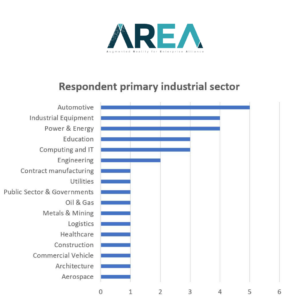
The survey attracted 43 respondents, with a good mix between those providing AR solutions and services (58% of respondents) and those using them (42% of respondents). Perhaps more importantly, we captured perspectives from a wide range of industries, as shown in Figure 1, with the highest levels of response from the automotive, industrial equipment and power and energy industrial sectors.

Figure 1 Primary industrial sector of survey respondents

AR adoption now and in the future

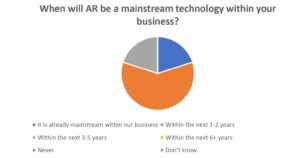
When asked “When do you see AR becoming mainstream in your business?”, 20% of our survey respondents stated that AR is already mainstream in their business. Another 60% of respondents believe that AR will become mainstream within 1-2 years, with the remaining 20% suggesting a longer timescale of 3 to 5 years, as shown in Figure 2. Perhaps unsurprisingly, no respondents chose “never.”


Figure 2 Perspectives of when AR will become mainstream

Where should academia focus on educating students?

Our next question, perhaps the most significant of the survey, requested views on where academia should focus on educating the graduates of tomorrow. Respondents were asked to rate each of the following graduate attributes from 1 (least important) to 10 (most important):

  • Deep technical familiarity with the underpinnings and principles of AR software or hardware
  • A strong theoretical foundation of how AR technologies can benefit industry and society
  • Practical experience developing (coding, authoring) AR applications
  • Practical experience and understanding how to apply AR technology to “real-world” business challenges
  • Familiarity with using AR as a tool in business settings and use cases
  • An understanding of the business aspects of AR (costs and cost savings, ROI, safety, security, privacy)
  • Awareness of global and industry trends in the adoption and usage of AR
  • Experience with the human factors, ergonomics or user interface design of AR solutions

The distilled answers to this question are shown in Figure 3. We order the answers by the number of respondents that suggested a value of between 8 and 10 (inclusive) for each educational need.

The responses clearly show that the “business-oriented” aspects of AR are believed to be more important than the underlying technologies and ergonomics. 75% of all respondents ranked the business aspects with scores of 8 to 10. In particular, 100% of respondents scored the educational need “Practical experience and understanding how to apply AR technology to ‘real-world’ business challenges” with a score of 8 to 10.

Perhaps this reflects an industrial requirement that graduates better understand how to apply AR technologies rather than the ability to build such technologies.

As such, it is clear that the results of our survey highlight a need for academia to equip the graduates of tomorrow with the skills addressing how to apply AR to business challenges and how to quantify and qualify business value, cost and other practical considerations.

Figure 3 Where should academia focus?

The importance of AR in university curricula

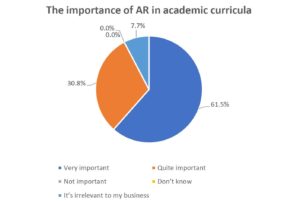
When asked “…how important do you believe it is, that academic institutions should include AR in their curricula?”, the answers were as shown in Figure 4.

61.5% of respondents answered, “Very important.” Interestingly, 92% of respondents deemed academic support for AR as either “Very” or “Quite” important.

Figure 4 The importance of AR in university curricula

If these answers reflect a sentiment shared across industries, then there is a clear message to academic institutions to include aspects of AR in various university courses of study.

AR skill levels of recent graduates

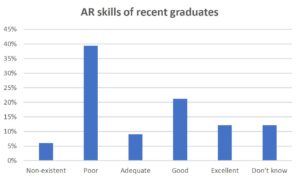
We then asked respondents to rate their impressions of the AR skills and experience of recent graduates. The results are shown in Figure 5. Of these results, 42.4% of respondents believed that the skills and experience were either adequate, good or excellent. More worryingly, 45.5% of respondents were of the opinion that the AR skill levels were either poor or non-existent.

The question did not dig into how the skills were acquired (e.g., by way of new-hire training) but nevertheless, the answers clearly represent a set of mixed opinions of how well-equipped recently graduated staff are to embrace and apply AR within the workplace.

Figure 5 Perceptions of AR skills of recent graduates

Industry’s willingness to engage with academic institutions

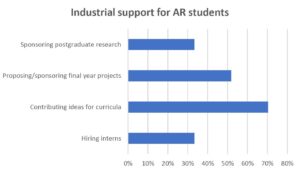
The last questions of the survey attempted to measure the level of interest expressed by industry to engage with the education process. Figure 6 illustrates an encouragingly high level of willingness to get involved with students in various ways with 70% of respondents willing to propose ideas for course curricula.

Figure 6 Ways in which industry would support student education

There are some clear indications that industry wants to engage further with academia whether it be by sponsoring postgraduate research, suggesting final year projects, or simply suggesting ideas for course curricula. Perhaps more notable from the point of view of the students, there is clearly an appetite for hiring interns with AR skills. 

Finally, when asked if they would be willing to discuss their answers further with AREA staff, 58% of respondents expressed a willingness to do so. We are grateful for their offers to engage further.

Conclusions

Whilst accepting that a response count of 43 is perhaps not statistically significant, the survey results obtained do highlight some key messages for the academic community:

  • The data captured by this survey is from a wide range of industries.
  • 80% of respondents believe that AR is either in mainstream use now or will be in 1 to 2 years.
  • Industry views AR education as important.
  • Academic courses should equip students with the knowledge of how to apply AR to business use cases along with other business aspects such as ROI and cost.
  • The majority of respondents believe that recent graduates are under-skilled in AR
  • Industry is willing to engage with academia to help improve this.

The message is clear: there is a need for AR in academic courses and industry is willing to engage to help make it happen.

Acknowledgements

The AREA team wishes to thank all of those who participated in this survey.

We gratefully acknowledge the assistance of Professor Barbara Chaparro, Embry-Riddle Aeronautical University, in the construction of this survey.