5G and ThirdEye Gen mixed reality glasses help change how we see the world

Mixed/Augmented Reality glasses require a high bandwidth to effortlessly transfer the large amount of data that AR/MR requires.  With Verizon’s 5G network, this is finally achievable.

With a 5G network, ThirdEye glasses are able to offload the majority of their workload to the edge of the network due to the increase of bandwidth and reduction of latency. Since a large part of the workload is being handled on the edge, it allows for ThirdEye to decrease the weight and price of their glasses.

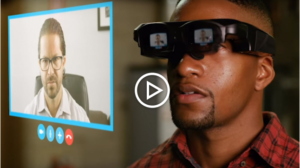
With ThirdEye’s Mixed Reality glasses, first responders can view a live drone feed or view other important AR information right in their field of view, all while remaining hands-free.  The glasses also have object recognition capabilities that makes working with unfamiliar objects easier and more engaging.

Read the full article featured on Verizon.


Vuzix Partners with SightCall to Deliver a See-What-I-See Field Service Solution

By leveraging their propriety global cloud communication platform, SightCall brings a robust, enterprise grade video solution to their customers.

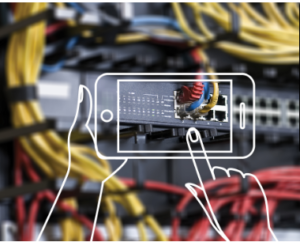
SightCall allows field forces to leverage augmented remote guidance from offsite experts. By doing this, SightCall reverses the traditional field service model where expertise was in the field, by making expertise available to the field remotely.

When a tech cannot finalize a repair, by simply clicking the Video Expertise button in their FS App they will connect to a central or field expert. When a customer is having an issue, a field tech can use remote guidance to implement a quick fix or identify missing parts or complications to ensure the onsite visit will be effective.

By avoiding several tens of thousands of truck rolls per month, SightCall’s customers save millions and provide a better service to their customers.

“SightCall currently has over 200 enterprise customers and their field service solution is a natural fit with our M300XL Smart Glasses, so we are very excited to partner with them offer a see-what-I-see solution,” said Paul Travers, President and Chief Executive Officer at Vuzix.

Read in full Vuzix press release dated April 25 2019


How AR and VR are driving return on investment in the Enterprise Reality Ecosystem

The article features many quotes and figures from thought leaders who are members of The AREA, Augmented Reality for Enterprise Alliance and is based on discussions across the industry extracted from Digi-Capital’s Augmented/Virtual Reality Report Q2 2019.

“While consumer AR/VR is proving itself, enterprise AR/VR is already delivering strong return on investment for major corporations like Walmart, Lockheed Martin, and Verizon.

But the market remains a series of connected point solutions, not a fully functioning ecosystem (yet).”

That YET is very important.

If you’ve not already been following the AREA for a while and fully understand our mission, this would be a good time to tell you that the entire existence of The AREA Alliance is devoted to developing a cohesive AR enterprise ecosystem and accelerating adoption of enterprise AR.

The article addresses how is enterprise AR/VR driving ROI today, and looks are what else it needs to scale across platforms.

The focus of the article is defining by number of users how many users are needed to qualify the term active users.

AREA members quoted in the article include PTC Vuforia, Upskill, Lockheed Martin.

Further related reading:

Read the full article on Venture Beat

AREA Enterprise AR ROI Best Practice (May 2018)

AREA Enterprise AR ROI Case Study


RealWear announces Shell Selects HMT-1Z1 and HMT-1 Hands free computers for field workers

From RealWear’s Press Release:

“A new era of computing has arrived. Just as laptops and mobile phones are standard for desk workers, voice command and augmented reality for wearable computers will become commonplace for field staff in our industry, driving safety and productivity.”

Michael Kaldenbach, Digital Realities Lead, Shell

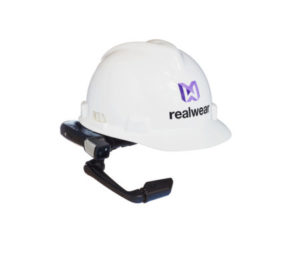
The RealWear HMT-1Z1 is an intrinsically safe voice-controlled device with a micro-display that shows an image to a user as if they were viewing a seven-inch screen. The head-mounted computer is the world’s first commercially available device that permits field workers in highly restricted ATEX Zone 1 C1/D1 zones to use a wearable device where potentially explosive gases are present, helping to reduce health and safety work hazards.

Shell is currently using the HMT-1Z1 for remote assistance. For instance, if equipment needs maintenance, a worker can get real-time assistance via a video call, allowing an expert to essentially see through the eyes of the onsite worker and offer over-the-shoulder assistance. In one example, an expert uses Augmented Reality to remotely “draw” on the worker’s screen which is visualized on the head mounted screen.

Shell has already field tested and deployed 40 RealWear HMT-1Z1s in multiple countries and under different conditions and is now looking to roll out the devices further.

“In close collaboration with Shell and together with RealWear’s technology, Honeywell helps to change the way field workers operate, enabling higher levels of competency, productivity and safety assurance. By addressing key customer needs, Honeywell supports industrial companies like Shell in their digital transformation journey.”

John Rudolph, President, Honeywell Process Solutions

Honeywell is the global supplier of the HMT-1Z1 and provides additional software applications, services and hands-on field knowledge.

“We are thrilled to be working with Shell and Honeywell on this historic connected field worker program. It is the people in the field who are at the heart of every company. This vote of confidence by Shell marks a turning point for the 2.7 billion deskless workers globally who increasingly require the same connectivity as those who sit behind a desk.”

Andy Lowery, Cofounder and CEO, RealWear

Shell is an early adopter of augmented and virtual reality solutions for plants and workers. The move to wearables and mixed reality is part of Shell’s broader digital transformation.


Atheer Air’s new release increases capabilities and productivity for enterprises

The new release is designed to further empower enterprises with richer reporting and analytics, enhancements to the “See What I See” video call experience and ease of use updates that allow mobile device users to be more productive, more quickly.

The new release also expands the range of supported devices to include the recently-released Vuzix M300XL smart glasses and the Samsung Galaxy S6, S8 and Google Pixel 2XL mobile phones.

Reporting and Analytics Dashboard

A well-designed reporting and analytics dashboard is a vital information management asset for enterprises. In this release, Atheer provides a new dashboard to provide at-a-glance insight into how effectively business processes are being completed and the overall level of workforce engagement with the AR platform. Key metrics tracked by the dashboard include statistics on platform’s top users, number of calls and taskflows completed (a taskflow is a set of work instructions) – as well as the number of messages sent and the average duration of calls.

Screen Sharing for Web Users

In the course of their work, an enterprise employee in the field will often use their mobile device (smartglasses, a smartphone or a tablet) to make a video call to a remote expert or a colleague using Atheer. Typically, the scenario will involve the field employee sharing what they see and then having the remote expert annotate what the field employee sees – or send digital guidance including work instructions or annotated digital phones – to help them carry out their job.

Now, those remote experts can actually share their screens using the Atheer web console and enrich the ways in which they can help field employees. Screen sharing allows remote experts to move from being able to share specific digital assets with field employees to being able to share anything on their screen.

This new feature gives Atheer remote experts the ability to share their web-based screens during video calls with one or more web and device users. Those users can also now use annotations while sharing their screen, allowing more precise and effective collaboration.

Get More Productive, More Quickly

When using AR-enabled mobile devices, particularly smartglasses, starting applications can be tedious and time-consuming. To help enable users to be more productive, more quickly, Atheer introduces a “Kiosk Launcher” option in this release, which allows smartglasses to launch the Atheer app by default without having to navigate to it or go through any other intermediate start-up processes.

This new capability also makes access to the Atheer app more efficient for multiple users on the same device, because it allows the device to boot directly to – and stay in – the Atheer app without any user login.

Greater Device Choice and OS-specific Enhancements

The new Atheer release adds to the list of supported devices. The Atheer platform is now optimized for use on Vuzix M300XL smart glasses and additional mobile devices including the Samsung Galaxy S6, S8 and the Google Pixel 2XL.

In addition, this release includes many other enhancements including the arrival of contextualization on the Atheer iOS app – which allows users to retrieve specific content by scanning QR codes. As well, the new Android version of Atheer now includes the ability to force “over-the-air” updates to ensure users always access the most optimized version of the app based on their organization’s update settings.


The Future of Industrial Innovation Is Happening at PTC Reality Lab

PTC is a technology company that made a name for itself in the CAD and PLM markets over the past 30 years, but it’s also a leader in the emerging technologies of industrial IoT (IIoT) and augmented reality (AR). On the top floor, the Customer Experience Center (CXC) highlights PTC’s breadth of experience with demonstrations of real-life customer use cases and applications.

Tucked into its own space is the PTC Reality Lab, the forward-thinking team of engineers and researchers charged with pursuing uncharted technology. The team of five – all alumni of MIT Media Lab – are at the forefront of industrial innovation, and spend every day exploring concepts and developing technologies that will enhance people’s interactions with the physical and digital worlds.

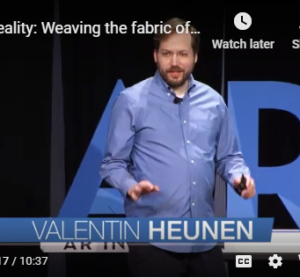
Valentin Heun holds a Ph.D from the MIT Media Lab and has long been interested in how to foster better connections between technology and humans – and how user interface design, particularly with augmented reality, can empower workers.

The full interview is worth a read in its entirety. Here is a snapshot of what is covered:

What is the vision for PTC Reality Lab?

What are some of its special features?

What are the benefits of the co-location of the PTC Reality Lab within the Customer Experience Center (CXC)?

Interview highlights from an enterprise AR perspective:

The former Media Lab motto, “demo or die” – or nowadays, “deploy or die” – permeates our lab here at PTC. What that means is that one must make something a reality and not just innovate into the blue. When we research and develop technology, we do so with a focus on the needs, problems, and applications of industrial companies.

We’re using augmented reality, generative design, additive manufacturing, artificial intelligence, industrial IoT, robotics, digital twin, just to name a few technologies, all in the context of the physical reality. These are technologies that influence or empower at least one version of what we call “reality.”

To me, this is the essence of what PTC and the PTC Reality Lab does – to shape a seamless and intuitive user experience that is only one reality.


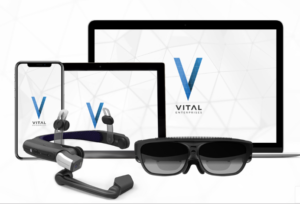
Vital Enterprises Providing Augmented Reality Superpowers To Industrial Manufacturing

Vital Enterprises is a company based at the Runway Innovation Hub in San Francisco. The company was founded in 2013 with the original goal to pursue healthcare applications of the newly emerging Augmented Reality smart glasses technology.

The interview is well worth reading in full for any enterprise already using smart glasses or considering doing so in manufacturing.  First comes a high level overview of Vital Enterprises, then more specific use cases which help us to understand the evolution of smartglasses technology.

They wouldn’t dream of building their own hardware but are focused on AR software.  Better for them if customers are already using smartglasses.  Some of the brands they use are Epson, ODG, Vuzix and RealWear.  RealWear Inc, also an AREA member, according to Eldritch, has a fantastic device built for industrial applications and is 100% voice controlled.

A detailed use case is discussed of a problem presented by an industrial manufacturing enterprise customer, a multinational based in Italy.  They also detail their work with Coca Cola. The article concludes with some thoughts on the new capabilities that the Vital Enterprises team is excited about and the future trends in the field of AR smart glasses.


How Porsche Transformed Automotive Dealer Service with AR

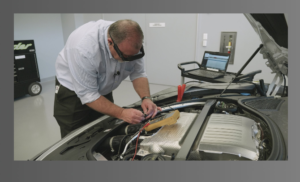
Previous articles have examined other talks such as by Scope AR another AREA member. Joining the list is Atheer‘s work with Porsche to drive 40 percent faster maintenance using AR assistance. This says a lot according to Atheer’s Amar Dhaliwal at AWE, given that Porsche was already operating at an elite level.

“These are some of the most trained, certified and competent auto technicians in the world,” he said (video below). “It can take ten years to actually become a gold-certified technician. Yet when Porsche rolled out AR, it was able to achieve a 40 percent reduction in service resolution time.”

In fairness, this isn’t a new figure. In fact, Dhaliwal is first to admit that Porsche has already publicized the 40 precent stat, and for good reason. It’s a subtle message that they’re investing in AR so that customers are in good hands. This makes AR part operational and part marketing.

“When somebody’s going into a Porsche dealership they probably came from a Mercedes dealership and going to BMW next,” he said. “Porsche wants to be able to tell customers ‘Not only are you buying the best technology, but we’ll look after you once we’ve sold you the technology.”

This message makes sense because Porsche’s point of deployment for AR is at the dealer level. It’s the dealer-centered technicians that are using AR to fix cars that Porsche owners bring in locally. So AR’s presence and value can be that much more apparent to the end customer.

As for how it achieved that 40 percent, the first step is planning and needs-assessment. AR is only successful when applied in the right places. As we heard from Scope AR, it’s not a silver bullet: It can only be successful when used to solve specific problems in specific job roles.

Here, one important distinction according to Dhaliwal is training versus guidance. AR doesn’t really do much for jobs that require training (repetitive, simple tasks). But it can have lots of impact in jobs that need guidance (complex, non-repetitive tasks). Pinpointing this should be step one.

“We’ll start by saying ‘what is it that you’re trying to do?’” he said. “If they’re trying to do something that sounds better for training, we’ll say ‘we’re not the right partner for you, because deploying this technology to solve this problem will not have the ROI that you’re looking for’.”

The next step is to win over end-users, such as technicians — a lesson we’ve heard over and over. And the name of the game is simplicity. For example, when possible, start with simpler forms of AR such as remote assistance, before graduating to things like pre-authored sequences.

“Industrial workers, the people who are the principle users AR, have very low tolerance for complexity.” said Dhaliwal. “Complexity is your enemy when rolling out to the industrial worker. That’s a fact and I think it’s important in terms of how we design solutions as an industry.”

And the simplicity angle works on many levels. Atheer also owes its success with Porsche to simplifying the business model. In its case, it faced an additional challenge of working with individual dealers, so it created an end-to-end offer where it handles all of the logistics.

“All the glasses come into our office,” said Dhaliwal. “We pre-install the software, set up the users, put in all of the manuals and guidance. We package them up with Porsche’s branding and send them out to the dealers, because Porsche is saying “that’s not what we’re experts in.”

Several of these tactics make enterprise AR success factors extend well beyond the technology itself. It’s about speaking the language, knowing the vertical you’re selling into and PR. That brings us back to the first point: AR can boost, and be boosted by, fundamentals in marketing.

“Act like a marketer,” advises Dhaliwal. “Porsche chose to brand everything as ‘Tech Live Look.’ So everything they do, every press release, every analysts briefing, they talk about the program. Internally, the posters and packaging… when glasses go out… everything is branded.”

The talk can be seen by watching here: Amar Dhaliwal (Atheer) How Porsche Transformed Automotive Dealer Service with AR:



Crunchfish and Nibiru provide AR gesture control for Polaroid

Nasdaq First North-listed Crunchfish entered a partnership with the Chinese company Nibiru in 2018, where they will re-sell Crunchfish’s gesture control technology as an integrated part of their system for AR and VR. Nibiru has now signed agreement with Chinese based Shenzhen ARTS-STAR Technology for a Polaroid branded all-in-one AR-HMD.

The Polaroid AR-HMD is initially for the Chinese market but target a global market as a next step. The AR-HMD has a consumer profile but will also target other areas like museums and education.

“The collaboration between Nibiru and Crunchfish enhance the interactive ability of Nibiru AR- system. The convenient and lightweight gesture interaction adds more usage scenarios of XR. Nibiru and Crunchfish mutually benefit from their cooperation and work together to provide more user-operation friendly AR/VR interactive technology”, says Nibiru VP Peter Liu.

“On the basis of not increasing any hardware cost, we make our devices and interaction more convenient and user-operation friendly. As for our products, product strength and market competitiveness have been improved. Nibiru and Crunchfish provide us with an integrated solution that allows us to focus only on production” says Polaroid General Manager Jeff Zou.

“We are very happy to be part of Nibiru’s successful roll-out of their AR-system. Polaroid is a strong brand and will play an important role in the marketing of our joint offer with Nibiru”, says Crunchfish CEO Joakim Nydemark.

The cooperation with Nibiru strengthens Crunchfish’s position further as one of the leading suppliers of gesture control for smart AR-glasses. Over the last year, Crunchfish has entered several strategic partnerships with major global players, which is a key factor for success in a growing market.

For more information, please contact:

Joakim Nydemark, CEO,
+46 706 351 609,
[email protected]


Vuzix strikes reseller partnership with Verizon for enterprise customers

Per the agreement, Verizon Sourcing, the subsidiary that handles procurement of the inventory that Verizon sells, will offer the Vuzix Blade, M300XL, and M-Series smartglasses and accessories, as well as the Vuzix Basics Video software.

Vuzix will deliver inventory to Verizon based on purchase orders, with the initial agreement set for a three-year term. The filing states that orders are expected to commence in the second quarter of 2019.

While AT&T’s strategic partnership with Magic Leap is consumer-facing, Verizon Sourcing’s agreement with Vuzix targets the enterprise sector.

“The initial focus is on business, government, and education to deliver a turnkey solution to Verizon’s largest enterprise customers,” said Paul Travers, CEO of Vuzix, in a statement to Next Reality. “There is a tremendous amount of value that could be delivered through 5G connectivity and smart glasses and as we could see how this relationship could expand to consumers and across the board with 5G.”

So, while augmented reality remains entrenched in the enterprise arena, hardware makers and the mobile carriers who stand to benefit from delivering 3D content and AR experiences to users have their eyes set on the potentially more lucrative consumer realm.

Watch Vuzix video