Saab to integrate Varjo Mixed Reality Technology into Gripen E/F simulators

Saab announced on 7 June that it would be working with Finnish firm Varjo to integrate the company’s technology into all simulators for the Saab Gripen E/F aircraft.

Saab’s Head of Tactical Environment Simulation and Visualisation Stefan Furenbäck said in a statement, “We are finalising the basic functionalities in our own simulator so that we can use Varjo’s XR-3 headsets in all our flight simulators. We’ve previously carried out smaller, independent prototype-like projects but now we’re integrating them into our actual flight simulators.”

A key aspect of this, according to Furenbäck, is that Varjo’s technology had allowed pilots to be able to read text and see small details when using the technology, which had been a common concern with other simulator systems.

As a result, the ability to use a high-fidelity goggle-based system has reduced the need for large static and semi-static simulation cave or dome systems for pilot training, allowing for improved training and mission rehearsal to take place at disparate locations that may lack the necessary infrastructure.

Seppo Aaltonen, chief commercial officer at Varjo, told Janes in late 2020 that the company had been working to improve the technology behind its goggle systems, which include the XR-3.

“If you think about commercially available devices, you can get 20–30% of the population feeling ill after usage. We specialise in the high-end professional virtual-reality and mixed-reality market. We have a host of technologies that we have employed to enable extended use, including ergonomics. One of these is individual pupil distance adjustment where we measure each student’s pupil distance and adjust the headset accordingly, and that reduces a lot of simulator sickness.”


AR and VR opens new doors for BMW Group

The article includes detail on the following:

  • Fast and flexible planning of new workstations in production, thanks to VR and digitised 3D factory data
  • Learning success and supervision quality with AR technologies as high as in one on one sessions
  • Authoring tool developed by the BMW Group makes it possible to design training courses without any coding knowledge
  • Target / actual comparison between camera image and CAD models for fast, straightforward quality checks of parts and vehicles

Read the full article here 


Augmented Reality Supports Space Advances

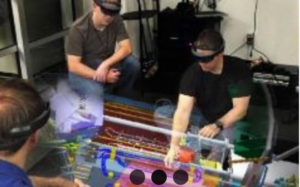
The mixed reality, computer aided design (CAD) 3D visualization tool is known as ProtoSpace. It has been crucial to the lab’s collaborative development of spacecraft, says the technical lead for ProtoSpace, Benjamin Nuernberger.


Nuernberger, a mixed reality researcher and developer who guides the Jet Propulsion Laboratory’s (JPL’s) related software architecture design and implementation, explains that ProtoSpace allows scientists to see 3D CAD models of the spacecraft through augmented reality. To use ProtoSpace, researchers employ the Microsoft HoloLens, a commercial off-the-shelf mixed reality head-mounted display device combined with the JPL’s augmented reality application to superimpose a 3D digital image into the real world—as opposed to a virtual reality environment that creates an entire digital world.


“ProtoSpace has been used for various stages of the mission life cycle, all the way from the stage where you have an initial CAD design and you want to communicate that design to other people, to the early design stage and trying to figure out the design decisions, then to find the optimal design and to validate those designs, and for planning and troubleshooting,” Nuernberger notes.


“It’s really great because all the different scientists and engineers can collaborate and see this spacecraft spatially, stereoscopically, floating in a conference room, or maybe overlaid onto the actual hardware in a clean room. It allows them to talk about it as if it was physically there.”

In February, NASA deployed Perseverance to Mars for two Earth years to search for signs of ancient life, collect rock and soil samples, demonstrate technology and advance the possibility of human exploration on the planet. In April and May, NASA conducted several successful demonstration flights of Ingenuity, first verifying that powered, controlled flight was even possible on the Red Planet, and later testing how aerial reconnaissance and other tasks could aid in the exploration of Mars.


Read the full article here


Rockwell Automation Unleashes New Possibilities for Industrial Companies in Asia-Pacific with LifecycleIQ(TM) Services

LifecycleIQ Services provide the transformative partnership that customers need and expect today. By combining digital technologies with expansive human know-how, the services help companies work faster, smarter and with greater agility at every point in their business cycle. The services can help companies realize the power of a Connected Enterprise during the design, operations, and maintenance stages in greenfield and brownfield facilities.

“LifecycleIQ Services create a more intimate customer engagement model, one that can help companies not only solve problems, but also see new possibilities in production and transform them into reality,” said Frank Kulaszewicz, senior vice president, Lifecycle Services at Rockwell Automation. “We’re investing in providing a wide range of holistic services to help companies be more productive, safe and secure anywhere in a product, process or plant lifecycle.”

Inbavanan Rathinam, senior director, Solutions & Services, Asia-Pacific at Rockwell Automation, said: “One challenge faced by many industrial players in Asia-Pacific is how to adopt smart manufacturing technology quickly whilst seamlessly integrating legacy equipment and machinery. LifeCycleIQ Services help to address this unmet need holistically, enabling enterprises to be future-ready by incorporating agility and flexibility in both infrastructure and processes.

“Driving efficiencies also continues to be increasingly important to businesses across every sector in the region, with growing attention on sustainable operations. LifeCycleIQ Services enables our customers to better plan and service every aspect of the plant, from design to safe operations, enabling reduced energy usage, minimized wastage, and maximized output.”

Industrial companies can use LifecycleIQ Services to achieve outcomes like:

Capturing more value from digital transformation initiatives

Digital initiatives can struggle to get off the ground because companies don’t know what steps to take or where to start. Using the knowledge and experience within LifecycleIQ Services, companies can strategically plan, implement and scale their digital initiatives.

Support can begin with defining strategic objectives, identifying use cases and quantifying business value. Rockwell Automation can then continue to support customers through implementation, ongoing maintenance and continuous innovation.

Reducing risk with comprehensive cybersecurity support

Cybersecurity is a top priority today, but few companies have specialists with both information and operations technology (IT/OT) security knowledge. Rockwell Automation is uniquely equipped to address complex security challenges in IT/OT environments. The company understands the OT environment and how it interfaces with IT and follows industry security standards.

LifecycleIQ Services can help companies adopt a proactive cybersecurity approach and address the entire attack continuum — before, during and after an event. Also, as more companies connect their plants to remote workers and partners like original equipment manufacturers (OEMs), Rockwell Automation can help protect those connections with secure remote access and security posture assessment services.

Improving workforce support

Companies need new ways to support their workforces as they contend with global health challenges and skills shortages brought on by the retirement of trained workers and an influx of new technologies. They also need workforce support as they seek to make the most of IIoT technologies.

LifecycleIQ Services can help companies address their unique workforce challenges and gaps by assessing needs, identifying priorities and creating workforce development programs. Rockwell Automation also uses remote support capabilities and augmented reality technologies to help companies interact virtually with support engineers, strengthen skills with virtual training, and provide safety and security services without sending people into plants.

To improve customer experiences, LifecycleIQ Services is also introducing a new way to receive multiple services in one contract. An Integrated Service Agreement allows companies to select a package of offerings to simplify their support needs and have just one number to call to access experts and receive priority service. Companies can get 24×7 technical support, repair services, reports and analytics, field services and more, all in one integrated contract.

About Rockwell Automation

Rockwell Automation, Inc. (NYSE: ROK), is a global leader in industrial automation and digital transformation. We connect the imaginations of people with the potential of technology to expand what is humanly possible, making the world more productive and more sustainable. Headquartered in Milwaukee, Wisconsin, Rockwell Automation employs approximately 24,000 problem solvers dedicated to our customers in more than 100 countries. To learn more about how we are bringing the Connected Enterprise to life across industrial enterprises, visit www.rockwellautomation.com.


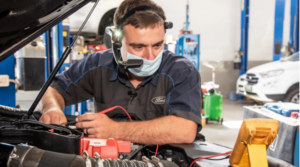
Ford Motor in South Africa Slashes Travel Expenses After Rollout of RealWear’s Assisted Reality Heads-up Displays

  • According to the report, the hands-free, voice-controlled devices provide on-site automotive technicians instant access to Ford expert advice no matter where their dealership is located.
  • RealWear assisted reality solutions have enabled automotive technicians in South Africa to perform complex and difficult repairs faster and more accurately than ever before.
  • Ford is using the solution to cut the expense of sending experts to every far-flung location in their dealership network.
  • The devices have also enabled Ford to boost customer satisfaction by reducing wait-times and ensuring vehicles are repaired correctly the first time.
  • Ford will expand their use of RealWear’s headsets to more remote dealerships in South Africa – as well as to other locations in sub-Saharan Africa.

Ford’s Announcement Says it Gained Business Benefits From the RealWear HMT-1 Hands-Free Deployment

According to the article, global innovation leader Ford Motor Company has gained a series of business benefits after introducing RealWear HMT-1 assisted reality devices in their South African dealerships. Ford had previously rolled out RealWear’s solution in parts of Australia and Europe.

List of Benefits Provided

Ford is enjoying many benefits throughout their South African Dealerships. These include:

  • The ability for remote technicians to gain real-time access to Ford experts so they can complete difficult repairs faster, easier and more accurately than ever.
  • The ability to eliminate vehicle repair bottlenecks cause by the delays in on-site expertise.
  • The ability to significantly reduce the enormous expense of sending vehicle repair experts to far-flung remote locations.
  • The ability to boost customer satisfaction by repairing vehicles correctly the first time – and reducing customer vehicle downtime.

Ford says its employees have been very happy with RealWear’s solution.

Read the full article here. 

See RealWear’s AREA member profile here. 


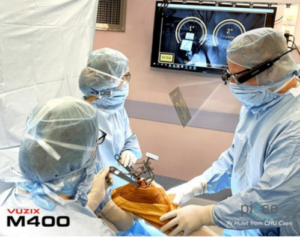
Pixee Medical Surgery Solution Has Received Clearance to Enter U.S. Knee Surgery Market with Vuzix AR M400 Smart Glasses

Knee+ is a patented platform designed to assist orthopedic surgeons to perform surgeries better and faster by providing real-time positioning of instruments, directly in their field of view. Knee+ is intuitive and requires minimal training even for those who have never utilized navigation or robots since it does not change the overall technique for 90% of surgeons who use a conventional technique. Knee+ consists of proprietary software using unique computer vision and artificial intelligence algorithms and running on connected Vuzix M400 Smart Glasses, with no bulky capital equipment or disposables required. The solution is simple, accurate and much less expensive than surgical assistance robots.

The United States represents 50% of the worldwide market for knee replacement surgeries, and according to estimates there are more than 30,000 orthopedic surgeons in the U.S who carry out approximately 600,000 total knee replacements annually. Pixee Medical plans to start surgeries as soon as possible in the US with Digitally Augmented Surgeons to prove the efficiency of its breakthrough, affordable, and efficient solution, especially adapted for the growing surgery vertical of ambulatory surgical centers.

“The FDA’s clearance of Knee+ is an important step forward and we plan to quickly expand our platform to perform hip and shoulder replacements,” states Sébastien Henry, Founder and CEO of Pixee Medical. “In addition, our platform is designed to become the cornerstone of data acquisition and exchange during surgery as well as a plug-and-play hub for accessories like connected instruments, robotic arms and wireless tools. Vuzix’ M400 Smart Glasses play a vital role within our Knee+ solution.”

“We are thrilled to see Pixee Medical receive FDA clearance for Knee+ and we look forward to supporting the worldwide distribution of their innovative AR solution, particularly now in the U.S. market, which accounts roughly half of the world’s annual knee surgeries,” said Paul Travers, President and Chief Executive Officer at Vuzix. “The Vuzix M400 Smart Glasses are lightweight, comfortable and completely wireless and their high-performance camera is ideal for reading QR-code markers and precisely calculating the 3D coordinates of the instruments used during Knee+ surgeries.”


New AR deal to help steel industry protect vital skills and move towards net zero

The project will initially use Vuforia Studio technology to overlay live data – taken from the ThingWorx® industrial platform – to various points of the facility, so that operators moving around will be able to make informed decisions on changes to casting and melting lines or troubleshoot issues before they happen.

It is anticipated that Augmented Reality will make it easier for staff to hae the right information at exactly the right point they need it, whilst the use of HoloLens and RealWear glasses will mean the individual has both hands free to complete tasks.

This project will contribute to the sector’s longer-term desire to move towards a net zero steel works by 2050 and is part of the £22m PRISM steel and metals sector research and innovation programme being delivered by the Materials Processing Institute with funding provided through Innovate UK, part of UK Research and Innovation.

“The successful implementation of digital technologies has the potential to save tens of £millions every year,” explained Chris Oswin, Group Manager of Digital Technologies at the Materials Processing Institute.

“We are taking responsibility for exploring IIoT platforms and AR and working out how we can get the most out of them in a live steel plant, learning from testing and trials to identify best use cases.”

He continued: “This means we absorb a lot of the time and remove the initial expenditure that could act as a barrier to entry for companies in our industry, hopefully encouraging digital adoption as we will have proved it works and how it can be applied to businesses.

“PRISM is guided by a team of industry leaders on our Industrial Advisory Board, including the Aluminium Federation, British Manufacturing Plant Constructors’ Association, British Steel, Celsa Steel, Liberty Steel, Outokumpu Stainless Steel, Sheffield Forgemasters, Swansea University, Tata Steel and the UK Metals Council.”

The Materials Processing Institute has a long-term relationship with PTC, with the latest project following on from the introduction of ThingWorx as part of the £10m programme to explore how digital technologies can be implemented in brownfield manufacturing sites.

In addition to optimising processes and introducing new efficiency improvements, Augmented Reality will also be used to capture some of the traditional skills in the sector that could be lost if the knowledge of older workers is not retained before they retire.

This will be achieved by using PTC’s Vuforia ® software, with Vuforia Expert Capture allowing operators and technicians to film their daily tasks in step-by-step instructions, in situ of when and where they do their work.

This will be uploaded to ‘the Cloud’, which can then be accessed by new starters or people switching roles, using HoloLens or RealWear to get a real hands-on experience, or other devices such as mobiles, tablets or on desktop computers.

Furthermore, for problem resolution and live ‘on the job’ support, there is Vuforia Chalk. Using mobile devices, digital eyewear or seated at a desk – experts can connect with on and off-site employees and customers and collaborate in real-time. It combines live video, audio and the ability for remote and local participants to annotate their live shared view and mark-up the real-world environment.

“If we don’t act soon, we stand to lose so much knowledge from the industry and AR gives us a cost effective and easy way to retain skills and experience in a virtual library for generations to come,” added Chris.

“Working closely with PTC’s experts, we can tailor how we capture information, footage and skills in what is a very demanding and intense environment. We believe we’ve got the initial framework to start the roll-out and will continue to adapt the processes as we understand more about how digital technologies can play a role.”

David Grammer, general manager for UKI for PTC, went on to add: “Covid-19 has definitely thrust the digital thread into the spotlight, but there is still a resistance to adoption due to a lack of awareness of how it will deliver a genuine business benefit.

“This project with the Materials Processing Institute gives an entire sector the opportunity to explore how AR can be applied and developed in a real live steel plant without the potential disruption and cost of trying it in their own facilities.

“Businesses will be involved in the roll-out and informing some of the test cases and our team will be on hand to support experts at the Institute to get the most out of our technology and software.

“The end goal is that we will have proven business cases on how steel and metals companies can optimise processes using Augmented Reality and live data, not to mention protecting vital skills for the steel workers of the future.”

PTC, which has bases in the UK and Ireland, provides a host of technology solutions to help industrial companies create value for themselves and the rest of the world.

This is achieved through a combination of Augmented Reality, Industrial IoT, Product Lifecycle Management and CAD solutions.



Mercedes Hopes to Gain Edge in F1 From Augmented Reality

Global software company TeamViewer (who recently acquired AREA member Upskill) which has just become Mercedes’ third biggest sponsor in its $300 million (USD) total portfolio, works with many industry partners in helping provide Augmented Reality solutions.

Mercedes believes there is scope for AR to help improve the speed of problem solving at grand prix events, help ramp up processes and also reduce expenditure in the cost cap era by it not requiring so many staff to travel to races.

The idea is that the AR systems would allow a direct live contact between personnel working at the track and related staff at factory that would provide a vital link on F1 race weekends.

Asked about the potential benefits by Motorsport.com, Mercedes team boss Toto Wolff said: “Formula 1 is a sport that travels around the globe. And in the same way as we have our race support room, where we have around 30 people that monitor the car, that work in the simulator, and in the wind tunnel to enhance the performance on track, we need to inspect high tech parts, such as the power unit hydraulics components and gearboxes.

“I think having remote access from the factory through the augmented reality possibilities that TeamViewer provide is going to give us an edge.

“The benefits are also that the remote work that we all have experienced in the last 12 months is also helping us to reduce our carbon footprint. We will be able to take less people to the racetrack, because the remote access will allow us to have exactly the same kind of potential in working with our engineers on the track even when they are back at base.”TeamViewer CEO Oliver Steil said that AR had been a huge help in other industries, so was something that could certainly offer opportunities in F1.

“In manufacturing, logistics, repair, inspection, testing healthcare, we have solutions where the worker wears glasses and gets step by step instructions on those glasses,” he explained.

“When you have a very, very complex inspection of an aircraft engine for example, then you can have somebody on call who is a trained engineer but working in a different location – and they work together to solve a problem.

“We have many different use cases. It is really gaining momentum now across industries in a way, to either help people perform more complex tasks or to upskill existing workforces. Or you can just have higher quality, and a faster understanding, of what has worked and how the parts flow works.

“It’s what we’re offering many customers around the world, mostly large enterprises that are deploying the solution. I think over the years, there will certainly be an opportunity to discuss this also in the sports arena.”


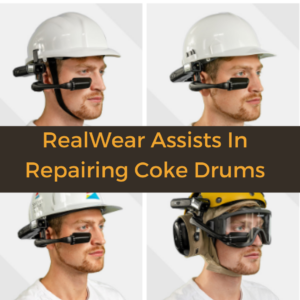
RealWear Assists In Repairing Coke Drums

Becht was awarded a project to perform a “Repair versus Replace” analysis of failing coke drums at an Indian Refinery.  Due to travel restrictions, the Becht team was unable to travel to the site for field walk-downs and inspections.

Becht utilized an in-country sub-contractor (Ingenero) to perform the walk-down utilizing the RealWear glasses which allowed the Becht experts to be there virtually for important field visits in the absence of being able to visit on site.

Utilizing RealWear smart glasses gave the Becht team a better perspective than drawings and photos ever could.


Read the original case study on Becht’s website.

Read RealWear’s AREA member profile.


Roundup on AR Devices and AR Smartglasses April 2021

Whilst the consumer side has not been entirely successful as yet, it looks as though producers are betting on the enterprise and industrial customers.

  • Facebook‘s AR/VR research division last month showed off its futuristic wristband for controlling AR glasses. The company’s Ray-Ban smart glasses will arrive later this year, though they won’t have an integrated display. They’re considered a precursor to future glasses with full augmented-reality features.
  • Last week, Niantic CEO John Hanke teased what appears to be a see-through headset or smart glasses; he said the company is working on “new kinds of devices” that leverage its augmented-reality platform. (The WSJ reports that Niantic is developing AR glasses with chipmaker Qualcomm.)
  • Apple is expected to reveal its $1,000+ AR/VR headset in the next several months, possibly during Apple’s virtual Worldwide Developers Conference in June. They’re a forerunner to Apple’s more complicated AR glasses, due out by 2025.
  • Snap, which already sells its Spectacles smart glasses with a camera but no display, is expected to reveal its AR glasses in May at its Partner Summit. After that, Snap will ship the glasses to developers and creators.
  • Google opened up its Glass Enterprise Edition 2 AR headset, geared toward businesses and developers, for direct purchase last year. Now, the WSJ reports that Google is “likely to try a consumer play again” in the AR space.
  • While fewer than 1M AR glasses and headsets are expected to sell this year, IDC projects that will skyrocket to 23.4M in 2025, mostly on the business side:

You can read all about it in the original article on the Wall Street Journal https://www.wsj.com/articles/facebook-apple-and-niantic-bet-people-are-ready-for-augmented-reality-glasses-11617713387