2019 H1 AR Event Season Reveals Growing Interest and Momentum
The months of May and June bring a flurry of AR events that
the AREA and its members support. So, with my travel bag in hand and a list of
industry experts with whom I would like to meet and discuss the work of the
AREA, panels to chair and talks about the growth of the enterprise AR
ecosystem, I say goodbye to my family and travel to the US.

VRX Immersive Enterprise – Unleash the Full Potential of
XR in Enterprise – 21/22 May, Boston

I’m always excited to attend enterprise-focused events like
VRX. This was my second year and it continues to grow. The speakers were
excellent, albeit perhaps focusing more on VR than AR. This year I moderated a
panel titled – AR for enterprise – What’s happening now and what does the
future hold?

I was joined by:

  • Rich Rabbitz, Lockheed Martin – I’ve been
    lucky to chair a number of panels with Rich, he is an expert and practitioner
    in the AR space.
  • Doug House, Porsche Cars of North America
    – Doug and his team have pioneered the use of remote assistance to make service
    at its dealerships hugely more efficient.
  • Caroline McManus, PTC – Caroline is a Senior
    Market Strategy Analyst, Augmented Reality and was able to provide real insight
    and experience to the panel.

 We covered the key
use cases being implemented in the industry, the benefits / ROI (both tangible
and intangible) that the companies deploying AR have received, and the
challenges they have had to overcome (including convincing stakeholders to
invest, safety, security and technology issues). A great panel and engaged
audience!

As part of the AREA’s media agreement with VRX, I offered
and ran a mini-master class on Enterprise AR. This intimate, interactive
workshop was a great way to present the work of the AREA. The focus is on
highlighting its members thought leadership, explaining the key use cases
(problems being solved), case studies (examples of companies deploying use
cases) and how to overcome potential barriers to adoption. A good session with
lots of positive feedback!

AWE US – 29– 31 May, Santa Clara

After a few days back in the UK, I once again boarded a
plane to the US – this time, Santa Clara. This was my fourth time at AWE US, an
event that is always well-attended with the expo floor growing year over year.
The number of speaker tracks has also increased.

The AREA was unable to secure a speaking slot this year but
did run a very successful AREA meetup. With an 8 am start on Thursday morning,
coffee and doughnuts fuelled the conversation. Our thanks to AREA member PISON for allowing us to use their
meeting room. Over 50 earlier birds attended and heard from AREA sponsor /
board members. Brian Vogelsang from Qualcomm, Marc Schuetz from PTC, Christine
Perey from PEREY Research and Consulting, Jay Kim from Upskill, and Peter Tortorici
from Medtronic all discussed the experiences, insights, and benefits they have
gained from AREA membership.

We also heard from a few of the AREA Committee chairs (the
AREA runs monthly calls focusing on working together to reduce barriers to AR
adoption including Research, Safety, Security, Human Factors, Marketing and
Requirements). Tony Hodgson from Brainwaive (Security Committee Chair) and Christine
Perey (Research Committee Chair) spoke about the objectives and deliverables
from their respective groups.

Back home for a few days, bags packed and I’m excited to
attend…

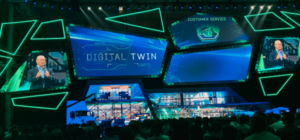
LiveWorx 2019 – 11 – 13 June, Boston

It was my first visit to LiveWorx and really enjoyed the
experience! The event is focused on helping companies digitally transform. PTC
CEO (and AREA member) Jim Heppelmann delivered a keynote that covered a wide
range of solutions including the latest PTC AR technology, featuring live demos
of many of PTC solutions. There were also many speaking tracks, including one
dedicated to AR.

I was delighted to present the work of the AREA in a 45-minute
session titled “The State of Enterprise AR.” We drew a sizeable audience, and I
was able to cover many subjects including: the history of AR (using Gartner’s
hype cycle); the key use cases being deployed; and the how the AREA’s research
work – including the AREA
ROI Calculator
,  Research
in AR Wearable Security
and AR
Human Factors and Safety framework
– are helping to overcome barriers to
adoption.

The AREA members wanted to offer an in-depth, insightful and
comprehensive workshop, so I was honoured to be joined by Shelley Peterson
(Lockheed Martin), Mary Claire McLaughlin and Rachel Boykin (Newport News
Shipbuilding) and Chris Ambrose (Strategy Analytics) in running a 90-minute
workshop.

With a focus on interaction, the attendees were able to ask
any questions to the team. We covered a wide range of topics on enterprise AR,
from detailed questions on use cases to ROI and benefits. We also addressed a
wide range of barriers and how these companies had successfully deployed AR. It
was a great session and the feedback was amazing, with everyone who attended
thanking the team for their honest insight and feedback. It was a great way to
finish the event season!

Thank you to the event producers, the companies sponsoring
and the attendees. Our industry continues to grow and with more real-world case
studies and enterprises deploying AR solutions, I look forward to kicking off
the 2019 second-half event season!



Developing AR and VR for Public Safety

Attendees will gain insight into the following topics:

  • What is the goal of the US Department of Commerce’s National Institute of Standards and Technology, and, in particular, the Public Safety Communications Research program?
  • How is NIST studying human factors and developing AR and VR tools for Public Safety professionals?
  • What have the challenge programs and initiatives produced to date?
  • How has the Public Safety community responded to the technology demonstrations and use cases?
  • How is usability for Public Safety measured and improved?


Embry-Riddle University

The Department of Human Factors and Behavioral Neurobiology at Embry-Riddle Aeronautical University, Daytona Beach trains students to understand the interactions of humans with other elements of a system. From neuroscience to human factors psychology, Embry-Riddle is the only university in the offering a bachelor’s, a master’s, and a Ph.D. degree program in Human Factors Psychology as well as a bachelor’s in aerospace physiology.

Background And Achievements

The Department of Human Factors and Behavioral Neurobiology at Embry-Riddle Aeronautical University, Daytona Beach is one of the largest human factors departments in the US. With 12 faculty, the department has eight research labs including Aerospace Physiology, Aging, Perception & Performance, Applied Cognition & Training Science, Game-based Education & Advanced Research Studies, Research Engineering and Applied Collaborations in Healthcare, Research in User eXperience, and Systems and Human Applied Research Performance.


Interview with Brian Vogelsang of Qualcomm

AREA: How would you describe Qualcomm’s role in the enterprise AR ecosystem?

Vogelsang: We’re a technology
provider in the ecosystem, delivering chipsets that power AR experiences. Our
Qualcomm Snapdragon platform provides the best silicon/chipset that we can
customize to meet the needs of the XR enterprise ecosystem. You’ll see them in
products today from customers like Vuzix and RealWear. Then there’s the
Microsoft HoloLens 2 that was announced at Mobile World Congress; it uses our Snapdragon
850 Mobile Platform. Vuzix also announced at Mobile World Congress their M400
platform, which is powered by the Qualcomm Snapdragon XR1 platform. Finally,
there are new, emerging OEMs, such as nreal, Realmax, Shadow Creator, and ThirdEye.
Our goal is to optimize technology to put more capability in lighter weight
designs that can drive more immersive experiences at the lowest possible power
levels, but with full connectivity.

AREA: People might have thought that Qualcomm was getting out of AR
when it sold the Vuforia business to PTC three years ago, but the company is
still very much committed to VR and AR, isn’t it?

Vogelsang: That’s correct. We’ve
been working for over a decade in this space. We have a long history of
computer vision expertise and exploring how to build the technology and optimize
it in hardware in ways that will allow more immersive experiences while running
at the lowest possible power. To date, that has been predominantly on smartphones.
However, our long-term vision is that within a decade, we will start
transitioning from a handheld device (smartphone) to a head-worn device or a
sleek AR glass that people use the whole day. And that’s really what we’re
looking at: how do we accelerate that innovation and make those kinds of experiences
happen – initially for enterprises, but long term for consumers.

AREA: So, you expect enterprises to be the early adopters of
wearables, then the consumer market will develop from there?

Vogelsang: That’s right. Today,
in the wearable form factor, there’s a spectrum of devices, from Assisted Reality
devices for remote expert or guided work instructions, to full augmented or
mixed reality devices like HoloLens or Magic Leap. Enterprises are willing to
adopt these technologies if they solve a problem and deliver an ROI – and we’re
excited about that. But long term, we think that the technology needs to get
smaller, lighter weight, and more ergonomic.  More like your standard eyeglasses. Because of
these size requirements, that’s going to be particularly challenging
technically. To deliver an immersive experience at the lowest possible power
requires deep systems expertise. That’s right in Qualcomm’s wheelhouse. It’s
going to take a few years for the industry to deliver mass adoption of consumer
class AR eyewear. So for the short term, the enterprise is going to be doing a
lot to drive the market.

AREA: How closely do you work with wearables manufacturers?

Vogelsang: We work really
closely with them on their products and roadmaps, collaborating with them to
achieve their market objectives. There are always tradeoffs as OEMS balance
cost, weight, form factor and ergonomics, optics and display capability, performance,
thermals, and often these impact immersiveness. And so we work really closely
with them to understand their use cases and objectives and then help them with
hardware, software, and support to meet their objectives. We also give them
insight into future technology developments and their future requirements
inform our chipset roadmap. We can’t solve all the problems. Things like
displays and optics as well as camera modules are a big part of the equation in
building an AR device, and while we don’t build those technologies, we work
closely with the suppliers of these components and assist OEMs with integration
through our reference designs and HMD Accelerator Program, which pre-validates
and qualifies components so OEMs can get to market more quickly.  

AREA: It seems as if technologies are starting to converge in new
ways: 5G networks, Artificial Intelligence, the Internet of Things, and AR. Do
you get that impression as well?

Vogelsang: Definitely. We see
5G as the connectivity fabric that’s going to allow the mobile network to not
only interconnect people, but also interconnect and control machines and
objects and devices. 5G is going to deliver performance and efficiency that
will enable these new experiences and connect new industries, delivering multi-gigabit-per-second
rates of connectivity at ultra-low latency. Latency is hugely important when it
comes to Augmented and Virtual Reality experiences. And of course, 5G means more
capacity. But AI is already being used in Augmented Reality experiences, enabling
things like head tracking, hand tracking, 3D reconstruction and object
recognition or estimating light. AI is a really important part of that. And I
think 5G also will enable some capabilities to be moved off the device to the
edge of the mobile network – taking some capability and moving it to be
processed at the network edge. And that ultimately will help us enable lighter
weight designs with richer, more immersive graphics at that low power threshold
that we need. So all three – 5G, AI and AR – are coming together. And I think
IoT will be a part of AR in terms of syndicating information contextually about
the environment in an enterprise to an AR experience. IoT will feed the
insights, which will be bubbled up as AR experiences.

AREA: What do you hope to get out of being a member of the AREA?

Vogelsang: Qualcomm’s
customers are OEMs. We don’t sell to end customers, the people who would buy
those devices or experiences. However, we do need to understand what their
needs are so that we can better evolve our technology roadmap to support where
those end users want to go. So, one of the things that excites us about
becoming a member of the AREA is to begin hearing directly from some of the end
customers who are deploying wearable AR technology. We know this is a marathon
and we believe XR – spanning both Augmented and Virtual Reality – will be the
next computing platform. So, we’re taking a long-term view and investing now in
the technology that will enable this market. As a result, we’re very interested
in learning from other AREA members about how the technology is being applied
today to solve concrete problems in the enterprise so we can inform our roadmap.
Those learnings will help us deliver products that can accelerate the pace of innovation
and grow the overall AR wearable market. 

We’re doing some trials and
proofs of concept and other things where we get more directly engaged with end
customer use cases. So, being able to collaborate with other AREA members in
that space would be really good. Also, we’d like to get involved in the
committees. We have a human factors team here, and I’d like to get them engaged
with the work that’s being done on the human factors side. While we don’t build
end devices ourselves, we still need to understand as we’re building out
technology how human factors, such as weight, size, or thermals impact the user
experience and ergonomics.

We’d also like to get involved
in requirements. We think we’d really benefit from learning more about requirements
from a horizontal cross-section of the AREA membership. And finally, I think
we’d like to get involved in the marketing side, as well. We would be
interested in using our platform to help tell the story and accelerate industry
adoption.

AREA: Where do you see things headed in XR over the next three to five
years? What are the next big milestones people should be looking for?

Vogelsang: I think that we’ll
see a transition from smart glasses or Assisted Reality experiences to more
Augmented Reality or spatial immersive computing type experiences. Over the
next few years, that transition will really start to accelerate. We’re already seeing
the early promise of what’s to come with technology such as HoloLens or Magic
Leap. I’m really excited about seeing the companies who are deploying smart
glasses or Assisted Reality experiences today start to adopt Augmented Reality
or immersive computing in a much larger way.


Identifying AREA Member Research Priorities

The benefits of executing joint research projects, sharing results and spreading research costs across members were a few of the original motivations for the formation of the AREA.

Today members can benefit from past and current AREA-directed and financed research projects on the following topics:

Wearable Enterprise AR Security Report

AR ROI Best Practice Report and Use Case

AR Human Factors and Safety Report and Case Study

AR in Manufacturing

– Best practices when merging IoT, AI and AR

(if your organization is an AREA member but you don’t have access to the member portal or if you seek access to deliverables from past projects, please contact Mark Sage to request).

Increasing Impact and Value

Responding to our members’ growing and wide-ranging research interests we are looking at ways to increase the AREA’s research throughput capability.

Therefore, the Research Committee invites members to contribute to a joint Research Agenda which will guide research by non-member organizations as well as member-led, AREA coordinated research efforts. This new workstream is in addition to continuing the current practice of AREA-directed and funded research projects (see list above) and will focus on overlaps in members current research programs or roadmaps.

In order to formulate the first AREA Research Agenda without exposing specific members’ strategic plans or burning problems, this initiative will:

  1. Detect and capture overlaps in research interests in a confidential manner
  2. Explore new ways to share existing research resources for common objectives  

A first step towards the above goals will be to identify internal member research stakeholders and conduct interviews with them to capture:

  • Members’ research interests (their own research agenda) and possibly current research projects,
  • Compile any (past) research work which could be relevant for and shared with other members of the AREA,
  • Any recommendations or observations on research methodologies and suppliers

(All conversations fall under the AREA’s NDA policy)

In parallel, this project will identify and capture the research interests/programs of AREA academic members and their availability/capacity to support and/or carry out primary & secondary research (e.g., literature reviews or meta-analyses).

If you have any questions and/or would like to contribute to this research, please contact the research team.