Industrial uses of LiDAR Sensor on Apple’s iPad Pro
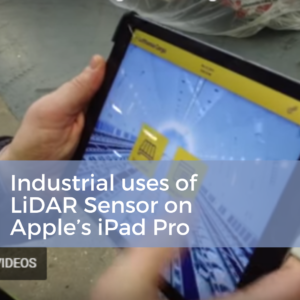
The LiDAR Scanner measures the distance to surrounding objects up to five meters away, works both indoors and outdoors, operating at the photon level at nano-second speeds. 

Not only Apple has got LIDAR-Features, Google is also working on this. They are planning to offer LIDAR-like features, with and without the use of a depth camera.

Application types using depth cameras

ViewAR AR system that supports all kind of AR scenarios – from AR product visualization and indoor navigation to remote assistance and much more. They also developed various applications using depth cameras and reconstruction using external cameras like the Structure.io sensor.

Measuring (Surface & Volume computation)

Using a depth sensor allows you to create a 3D reconstruction of a room or objects. This can be used in order to compute measurements and volume like they did in a project for Lufthansa Cargo a video of which can be viewed here.

The LiDAR Scanner also improves the Measure app, making it faster and easier to automatically calculate someone’s height, while helpful vertical and edge guides automatically appear to let users more quickly and accurately measure objects. The Measure app also now comes with Ruler View for more granular measurements and allows users to save a list of all measurements, including screenshots for future use.

Flooring

A depth sensor is also highly relevant for industries in the field of flooring. It allows you to visualize different flooring materials in a room. Also it provides accurate measurements of the flooring area.

ViewAR is currently working on a solution for flooring. If you are interested in this solution, register at portal.viewar.com and request early access for the flooring template. 

Product Visualization – Occlusion

One of the main aspects in product visualization is that objects should look and behave like they were real, they should merge with the environment. The 3d reconstruction allows to…

Indoor Navigation

There is also a huge opportunity for 3d reconstructions in indoor navigation. Scanning 3d environments can help to determine your position and also add advanced occlusion effects while using the application.  The 3d scans can also be used for admin interfaces of indoor navigation. 

Using the ViewAR system and the LiDAR sensor

The idea of the ViewAR system is that users can very easily create AR applications using pre-defined templates or use the ViewAR JavaScript API to create custom applications. 

Read the original article here.


ETSI unveils Augmented Reality Framework enabling multi-vendor ecosystem for industry and consumers

The ETSI GS ARF 003 introduces the characteristics of an AR system and describes the functional building blocks of a generic AR reference architecture and their mutual relationships. The global architecture gives an overview of an AR system which is based on a set of hardware and software components as well as data describing the real world and virtual content. The functional architecture applies to both fully embedded AR systems and implementations spread over IP networks in a scalable manner with subfunctions. These subfunctions can either be deployed on the AR device or be provided via cloud technology.

“In the context of the work undertaken by the group, Augmented Reality is the ability to mix in real-time spatially-registered digital content into the real world, thus augmenting the user’s reality with accurate contextual information” says Muriel Deschanel, Chair of the ETSI ISG ARF. “AR can be a real asset for many use cases in Industry 4.0 or in the medical sector. With the significant improvement to network performance brought by 5G, in particular in terms of bandwidth and latency, cloud services will become essential to a larger number of AR use cases”.

One of the applications of Augmented Reality for Industry 4.0 is to help face the unexpected peak of activity of a factory, in case of confinement or staff shortage. When a manufacturing plant needs to significantly increase its production, the Operation Director will hire temporary workers or shift operators from another line. This new staff may not have the expertise and/or the time to learn his job. Augmented Reality will therefore enable an experienced operator located in another area to train, guide and give precise instructions to the new operator while limiting physical contacts.

How The AREA contributed to the work

“Through our Interoperability and Standards program, the AREA contributed directly to the ETSI ISG ARF’s work on this specification. Members also carefully reviewed and provided substantive and editorial feedback. The final specification offers insights about how products and services can be combined to provide rich experiences to customers in many use cases. With this ETSI framework, companies can begin to focus on their true “core competencies” and trust that their products will be easier to integrate with third party products and services.”

Learn more

To know more about this architecture, the Chair of the group, Muriel Deschanel, and one of the technical and scientific leaders in the group, Jérôme Royan,  will give you an “Overview of ETSI reference architecture for Augmented Reality solutions” in a free live webinar on 28 April 2020 at 4:00 pm CEST.  Register here


AR and VR deliver ROI via efficiencies and cost reductions

According to PTC, there are five common use cases for AR/VR in field service: identifying parts that need replacement, viewing technical information, remote customer service, employee training, and following complex maintenance procedures. Companies that help employees perform tasks more safely and quickly using up-to-date information delivered to their visor or headset will be rewarded with greater job commitment and motivation.

Another function is sales and marketing. VR and AR can dramatically improve or disrupt outdated processes and engagement models to demonstrate a brand’s unique value proposition. Companies utilizing virtual product models are finding real competitive advantage.

“Interactive applications engage prospects earlier, train sales/channel teams faster, shorten sales cycles, reduce product shipping costs and increases win rates,” said Dana Drissel, vice president of marketing at Kaon Interactive, provider of B2B sales and marketing applications. “Companies need to embrace and adopt new ways of working with the latest emerging technologies if they want to truly differentiate and stay competitive.”

One area with high ROI from virtual sales and marketing is savings in product shipping costs. Large, complex products cost hundreds of thousands of dollars to ship to and from sales meetings and tradeshows. 

Commercial and industrial printing firm, Ricoh USA, Inc., has a strong brand, product, message and customer service ethos. However, it was seeking an innovative, efficient and effective way to convey that strength to its customers and prospects virtually.

Ricoh’s portfolio of production presses and platforms are high-powered, technological innovations that offer high levels of customization and complementing software services that can cost up to $2 million at the highest end of its spectrum. For such a significant investment, potential customers want an in-depth examination of the products. Customers want to see them, watch how they work, and explore the features and benefits.

To ship Ricoh presses to demo sites around the world cost over $150,000 per printer, per event. With between six to 10 tradeshows in a typical year, the marketing team started asking themselves what alternatives could they offer their customers that delivered a similar experience, yet without the physical equipment.

The solution? A virtual product tour that is also available in augmented reality. Having an interactive, photo-realistic, 3-D-animated, virtual tour and AR experience of the printing press suddenly made it possible to demonstrate the capabilities and show the value in sales meetings on the sales rep’s tablet or laptop.

“To me, the application is just a virtual extension of our product,” said Mike Herold, Ricoh’s director of inkjet solutions. “Of course, it doesn’t take the place of visiting one of our Customer Experience Centers, but it’s a good interim step in the sales cycle.”


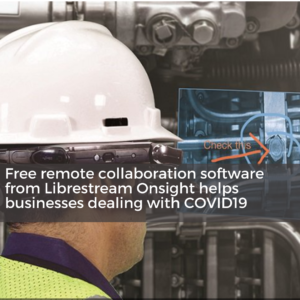
AR Remote Collaboration Software helps businesses dealing with COVID19

The Onsight platform allows workers to collaborate securely across multiple industries including aviation, defense, manufacturing, energy and inspection. The system also works in challenging areas where bandwidth and network connectivity are limited, such as a basement over cellular or an offshore oil rig over satellite.

The AR system can be used for remote inspections of equipment, diagnostic assessments and telemedicine consults. With travel restrictions and shelter in place becoming the norm, in-person meetings are not feasible anymore, so the AR platform allows workers at home to communicate with those in the field using both visual and audio aids.

The software runs on smartphones, tablets, smart glasses, wearables and computers.


How will COVID19 impact the manufacturing industry and HMD shipments

The Coronavirus outbreak will cause manufacturing delays at the source and reduce the overall demand for Augmented Reality (AR) Smart glasses. At the same time, there will be a significant increase in demand on both the enterprise and consumer side as telepresence and content demand grows. The balance between these two will see 16 million AR & Virtual Reality (VR) head mounted display (HMD) shipments in 2021, maintaining the trajectory of the 3.5 million consumer AR shipments in 2024, states global tech market advisory firm, ABI Research.

“The coronavirus outbreak will cause temporary manufacturing and shipment delays, however the demand for consumer AR and VR devices and content has been increased due to home isolation, balancing initial drop in demand and financial losses for providers,” says Eleftheria Kouri, Research Analyst at ABI Research.

COVID-19 has affected most CE companies, especially in mainland China, Taiwan, and South Korea. “As anticipated, COVID-19 has impacted the Augmented Reality (AR) and Virtual Reality (VR) market as well, causing temporary delays in AR/VR device production, increased costs, and revenue losses,” says Kouri. MAD Gaze, a Hong Kong based consumer AR smart glasses provider, has announced delays in shipments, and changed its display panel supplier from a Chinese factory to Korean and Japanese factories due to production delays in Chinese factories. Nreal, a China-based AR consumer smart glasses provider, announced production/ shipment delays as well. At the same time, bigger companies with higher demand and larger-scale supply chains face similar issues, such as Oculus, HTC, and Vive struggling to meet VR headset demand.

“In the short term, the delays in production and scheduled shipments, and potential decrease in demand will have a huge financial impact on AR/VR device manufacturers, generating reduced revenue and unexpected extra costs for employee salaries or for alternative suppliers. Also, delays and reduced funding series are expected, mainly affecting startups,” Kouri explains. Finally, delays are anticipated in AR/VR application development and upcoming upgrades due to the cancellation of developer conferences (Apple, Google, Facebook).

Long-term production and shipment delays will mainly affect smaller companies, especially those launching devices for first time in the market (like Nreal or small VR companies). Delays may encourage potential customers to purchase products from competitors and bigger companies that are supported by high-scale supply chains and product stocks. Moreover, continuous delays of product delivery will negatively affect user experience (even if the delays are caused by unexpected reasons). “The impact will be more significant on new companies/startups aiming to get established in the market and build a reliable brand name. Delays will also push roadmaps into the future and depending on how significant a reduction is in demand and manufacturing capabilities, some may be unable to last,” Kouri points out.

The AR consumer market and smart glasses manufacturers are at a relatively lower risk in terms of losing potential customers and may not notice significantly reduced pre-orders/shipments, because AR consumer devices are not a high demand product at the current stage of the market, and the competition is still weak (consumers do not have range of options as in the VR or AR enterprise sector). “However, both AR and VR solutions can contribute to addressing challenges. AR/VR can be a useful tool to support/supplement online education courses (in regions where schools/universities are closed and rely on online learning (e.g., some schools in the United Arab Emirates (UAE)). Also, AR remote assistance applications or AR/VR training can be a valuable solution to avoid unnecessary travel, and hardware choice is less impactful on these use cases,” recommends Kouri.

Press release source.


Theorem Solutions Whitepaper Digitally Enhance Your Workforce

A digital transformation strategy implies that your focus should be about the “digital”.  However, in the 21st century the human remains absolutely critical to how your business operates.  Therefore, in the world of connected machines, and through the implementation of XR, we need to digital enable our human workforce.

Theorem Solutions have developed a range of 3D CAD and hardware neutral, use-case based apps for XR.  These immersive experiences utilize your existing 3D assets, enabling your teams to perform tasks in the most efficient way possible, reducing costs and providing real measurable benefits.

Visit this link to access the whitepaper how to digitally enhance your workforce.

Read Theorem Solutions AREA member profile.


Augmentir Offers Free Remote Assist Software for Industrial Users

As COVID-19 continues to spread across North America, the CDC has suggested that businesses implement remote work policies and travel restrictions to help slow the spread of the virus. The situation has become more troublesome over the past few weeks, and many companies are looking for ways to help limit business disruptions while keeping the health of employees a top priority.

Russell Fadel, CEO of Augmentir, said on LinkedIn, “After hearing about the steps that Zoom, Microsoft, Slack, et al are doing to support remote work for White Collar workers – it became clear to the Augmentir team that we could do the same for manufacturing and service workers who rely on direct support for troubleshooting, maintenance, and repairs.

Augmentir’s Remote Assist software enables this support to be performed virtually, so that travel is eliminated and face-to-face meetings are reduced. Both are key to flattening the curve with respect to COVID-19, and to enabling our manufacturing sector to continue to supply the country with the goods it needs.

We have committed to providing this software free through the end of 2020 so that every industrial company can move to this new way of work, without encountering financial barriers to making the change.”

Therefore, in a response to COVID-19, Augmentir will be offering its Remote Assist tool at no cost through the end of 2020 in an effort to help the many businesses affected by the sudden increase in work-from-home policies and travel restrictions resulting from the global outbreak of the virus. We hope to curb the predicted impact this virus will have on industrial companies and will remain steadfast in our commitment to serving the industry we call home.” 

During this challenging time, video-conferencing, chat, and remote support and collaboration will be more important than ever in maintaining the wellbeing of employees while also enabling people to continue to work and businesses to operate. Augmentir’s Remote Assist tool helps to minimize the negative impact that COVID-19 is having on businesses by providing a remote collaboration and support solution that can be adopted in less than 60 minutes, so that workers, technicians, and customers can get the support they need to do their jobs without compromising health, safety, or productivity.

Companies that sign up will have free use of the tool for the remainder of 2020, and have access to the following features: 

  • Stream live video and audio to remote experts to improve issue resolution and remote knowledge sharing
  • Guide your field technicians and customers with live annotations for enhanced collaboration
  • Support remote users on their existing devices as well as AR-enabled smart glasses

For more information on Augmentir’s Remote Assist, and to sign up for free, please visit the Augmentir website.


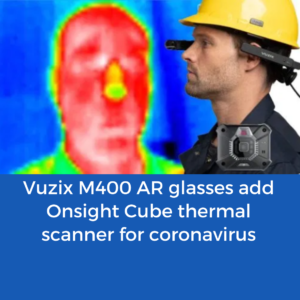
Vuzix M400 AR glasses add Onsight Cube thermal scanner for coronavirus

Vuzix is continuing a previously announced partnership with Librestream, maker of Onsight AR and collaborative software, to bring the thermal imaging technology to frontline screeners. While Vuzix provides the glasses, Librestream is supplying an industrial wearable camera called Onsight Cube, as well as Onsight software that helps wirelessly connect the screeners to viewers located elsewhere.

Backed by global medical experts or other officials. Colorful images provide heat maps that can be used to quickly detect body temperatures in excess of specific thresholds, as well as other heat flare-ups or reductions.

As the wearer looks at people around them and sees the camera’s raw thermal video, practitioners located elsewhere can capture snapshots or videos, adjust the lighting and zoom, and otherwise control the thermal settings. The companies expect that the wearable will speed up health data sharing and increase practitioners’ safety, in addition to letting front line workers take measurements without using their hands.

Concerns about the coronavirus have reached a fever pitch this week, as U.S. cities have clamped down on large public gatherings and the federal government has restricted travel from multiple countries. Infection and death tolls continue to mount, as the virus is believed to have a relatively high contagion rate while remaining largely undetected for days.

Read the full article on VentureBeat


XYZ Reality secures £5m to bring a hologram headset to the Construction Industry

To further boost its efforts, XYZ Reality has closed a £5 million Series A funding round, led by Amadeus Capital Partners and Hoxton Ventures, with participation from Adara Ventures and J Coffey Construction. The company will build out its AR cloud and software platform and build its team to serve the EU market and expand to the U.S. and Asia.

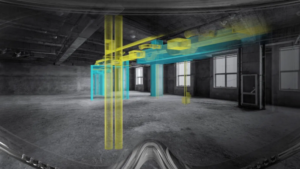
The idea behind it is highly innovative. A dedicated helmet with an attached visor projects a highly accurate hologram — based on laser positioning — in front of the wearer’s face, allowing them to place objects precisely according to plans projected in front of their eyes.

The company claims its HoloSite headset is the “world’s first engineering-grade Augmented Reality device,” that allows construction workers to view Building Information Models on-site to a five-millimeter accuracy.

The problem it’s solving is an age-old one. In today’s construction industry, buildings are designed in 3D and then converted into 2D drawings. But tradespeople are asked to interpret those 2D drawings and turn them into 3D buildings within construction “tolerances.” This process creates inefficiencies that mean up to 80% of the construction being “out-of-tolerance.” It’s estimated that 7-11% of project costs are wasted this way and, of course, in mega-projects like huge bridges, this amounts to an average of more than $100 million.

Founder, CEO and builder David Mitchell, who has spent his career in the construction industry, says: “Works are currently validated after the fact through laser scanning. But 80% of the time the construction fails to meet acceptable tolerances. With HoloSite, we can prevent errors happening in the first place.”

Mitchell came up with the idea of eliminating 2D designs after the 2008 recession devastated the industry.

I tried out the headset for myself and found that I could, with a reasonable degree of accuracy, from scratch complete a basic assembly of bricks according to the plans projected in front of my eyes.

XYZ says it is possible to build a bathroom in two hours using the headset, versus a day without it, using the technology.

The hope is that as this technology improves, any tradesperson would be able to work on a construction site with less need for training in 2D plans, but still with a high degree of accuracy.

The project is not without risk. Daqri, which built enterprise-grade AR headsets for construction, shuttered its HQ last year. Earlier, Osterhout Design Group unloaded its AR glasses patents after acquisition talks with Magic Leap, Facebook and others stalled. Meta, an AR headset startup that raised $73 million from VCs, including Tencent, also sold its assets earlier this year after the company ran out of cash.

But Amadeus is bullish. Nick Kingsbury, partner, Amadeus Capital Partners  said: “Construction is a sector that’s ripe for radical innovation. This technology has the potential to revolutionize how the construction industry sets out and validates its work, reducing costs and the chance of project slippage from mistakes.”


Augmented Reality 2020-2024 by Technavios Adoption of AR-enabled Smart Glasses to Boost Growth

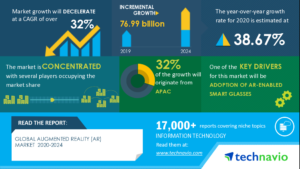
Technavio has been monitoring the augmented reality (AR) and it is poised to grow by USD 76.99 billion during 2020-2024. The report offers an up-to-date analysis regarding the current market scenario, latest trends and drivers, and the overall market environment. 

The market is concentrated, and the degree of concentration will during the forecast period. Qualcomm Inc., Samsung Electronics Co. Ltd., Upskill, Vuzix Corp. and Zugara Inc. are some of the major market participants. The adoption of AR-enabled smart glasses will offer immense growth opportunities. To make the most of the opportunities, market vendors should focus more on the growth prospects in the fast-growing segments, while maintaining their positions in the slow-growing segments.

Adoption of AR-enabled smart glasses has been instrumental in driving the growth of the market.

Learn more out the segmentation and scope of this report including sections and analysis on Business Wire.

You may download a free sample from Technavio