Augmented Reality Tech Maps Chem-Bio Threats

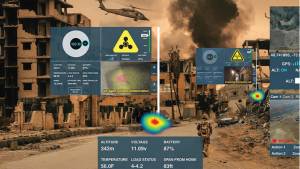
Teledyne FLIR announced it won a $15.7 million contract in December to develop augmented reality software that can pinpoint chemical, biological, radiological and nuclear, or CBRN, threats and map them for the military. The contract was awarded by the U.S. Defense Threat Reduction Agency’s Joint Science and Technology Office.

For reconnaissance and decontamination missions, a remotely operated vehicle would first move through an area where hazardous materials may be present and collect data using sensors, said Jeremy Walker, the director of science and technology for the company’s Pittsburgh location.

That data is then digitally registered and used to create an AR display of the area that highlights dangers, he added.

“As they’re moving through that space, they’re seeing these heat maps of where things were detected and what they are,” Walker said. “Once that data is captured by that tip of the spear reconnaissance mission, then many other subsequent users … can use that data to do their mission better.”

The mapping and AR technology will be integrated into the military’s Tactical Assault Kit suite of tools, which could be a mobile phone or tablet. Mixed reality headsets, like the Integrated Visual Augmentation System, are also an option, Walker said.

“All those people farther back don’t necessarily have to have sensors in their hand to know where the threat is to be able to do their work,” he said. “You’ve got this tool that helps people intuitively interact with it so they can keep their hands free to do other things.”

As it develop the technology, Teledyne FLIR’s Pittsburgh lab will be looking to work with existing and new partners in augmented reality and 3D-mapping spheres to help build the software, he said.


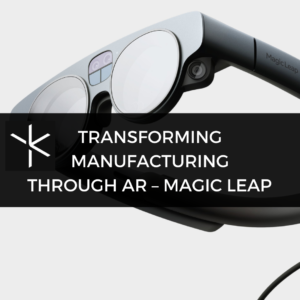
Transforming Manufacturing Through AR – Magic Leap

Overall, the solution helped PBC Linear operate and scale more effectively in several areas.

Deliver New Efficiencies and Process Improvements
PBC Linear utilized Taqtile’s Manifest on Magic Leap 1 to reduce training time for workers from almost three weeks to just three days – an 80% reduction in time.

Boost Productivity and Minimize Downtime
Along with reduced training time, PBC Linear saved almost $100,000 (USD) by reducing scrap and minimizing costly errors.

Attract Better Talent and Reduce Employee Turnover
New employees were enthusiastic to use Magic Leap’s augmented reality device to train more effectively and to increase productivity.

Simplify Training Procedures
Magic Leap’s device made PBC Linear’s training more efficient and interactive.

Save on Costs Tied to Training, Down-time and Human Error
PBC Linear realized substantial employee cost savings, including savings of more than $7,000 (USD) per employee across new machinist onboarding.

In case you missed this in-depth discussion of our manufacturing case study with PBC Linear and Taqtile, the webinar is now available for you to view. Watch Magic Leap’s video and resources 

Visit Magic Leap’s AREA member profile


3 Ways Augmented Reality Will Help Quality Managers

There are three ways that quality inspectors can benefit from augmented reality-equipped headsets:

Real-time Feedback with Computer Vision

Augmented reality-enabled headsets can provide real-time feedback to quality inspectors. By pairing an augmented reality (AR) headset (assuming it has a camera) with the latest computer vision software, an AI algorithm may be able to spot defects or anomalies in real-time. For example, industrial companies could integrate AI with upcoming AR headsets to automatically find flaws in production.

In layman’s terms, computer vision is the process of making sense of digital images. A computer can understand what is in an image and extract information from it. This can be used to detect objects, recognize faces, and track movement. For the industrial sector, computer vision helps find imperfections on surfaces or different pieces of equipment.

With augmented reality, headsets will provide real-time feedback to quality inspectors on the manufacturing floor. More importantly, AR headsets can superimpose graphics in the quality inspector’s field of view. By overlaying labels or annotations on top of the image, the quality inspector can be given feedback on what to look for and where to find it. This technique of defect superimposition will increase the accuracy of visual defect detection and the speed at which human inspectors do it.

Training and Guidance

New augmented reality technologies can also provide training and guidance to quality inspectors. By providing step-by-step interactive instructions, augmented reality can help new quality inspectors learn the ropes of a job quickly and easily. And for experienced quality managers, augmented reality can provide additional guidance on finding specific types of defects.

For example, automotive inspectors could use augmented reality to help them identify defects on a vehicle door. Additionally, augmented reality could guide the best inspection techniques to examine a product for defects. Such a technology would help ensure that all products are visually inspected in the same manner, thus increasing accuracy.

Training is important for all factory workers, but it is vital for people in charge of quality control, as they are the ones who determine whether a particular product is in or out of tolerance. Therefore, making training and on-the-job education more interactive and enjoyable for quality inspectors should be a priority for many manufacturers.

Data Analysis

Finally, augmented reality headsets can also be used for data analysis. After an inspection is complete, the data collected by the augmented reality headset can be analyzed to look for trends or patterns. This historical data could then be used to improve the quality inspection process.

For example, if a specific type of defect is common in one area of the factory compared to another, a manufacturer could take steps to address this. Or, if a quality inspector discovers that a particular product line has many defects, the inspector could take action to improve the manufacturing process.

It may be necessary to integrate multiple data sources to implement these improvements, but augmented reality can serve as a core visual baseline to bring outside data into the fold. By spatially registering machine-readable data, AR headset location, and on-device defect detection, a recommendation engine could suggest optimizations for production processes.

When Can I Expect to See AR In My Factory?

It is still early for augmented reality in the industrial sphere, but we can expect to see more augmented reality applications appearing over the next few years. For example, one of the first augmented reality headsets to be released for industrial use is the Microsoft HoloLens. Still, we expect major tech companies to also compete in this market.

In short, AR headsets may take a little while to become commonplace in factories, but augmented reality is not a technology to ignore. The benefits of augmented reality for quality managers are too great.

How to Get Started

If you are interested in learning more about augmented reality for the industrial sector, you can do a few things. First, attend some digital trade shows and technology conferences throughout the year. We highly recommend the NVIDIA conferences. These events will give you a good overview of the current state of augmented reality and where it is headed in the future.

Second, read some recently published white papers on augmented reality for industrial use. This will help you understand how augmented reality can be used in a manufacturing setting. In addition, white paper authors often include technical applications and guides, which can help develop a practical augmented reality strategy.

Finally, if you are looking for a more hands-on approach, consider hiring an augmented reality developer. They can help you develop an AR application tailored specifically for your needs.

Conclusion

Augmented reality can help quality managers find defects before they cause a problem. By pairing an augmented reality headset with computer vision, these quality managers will get defect-finding assistance on their augmented reality headsets when visually inspecting products. This technology is still in its early stages, but augmented reality will likely revolutionize the quality inspection process.


How 3 Industries Are Using Augmented Reality to Streamline Workflow

AR in Marketing 

With the average person being exposed to between 6,000 and 10,000 advertisements per day, a successful ad has to stand out to gain any traction.

Fortunately, marketing mediums can now be brought to life using AR. Using this technology, marketers can utilize 3D animations in brochures, billboards, and even on storefronts. When ads incorporate AR, it’s almost like the viewer is playing a video game, which keeps them engaged and interested in what’s being advertised.

Coca-Cola, for example, created a successful AR ad for its Arctic Home Campaign. This campaign focused on protecting polar bears and maintaining their habitats. Through an interactive ad, visitors could attend an augmented reality event at the Science Museum in London and interact with virtual animals. This innovative event took Coca-Cola’s campaign from mere words on a page explaining why saving polar bears was important to creating a connection between viewers and the cause.

Taco Bell has used AR to advertise itself in sillier ways. Using a Snapchat filter, users were able to turn their face into a Taco Bell taco and share it with friends through the app. Other companies like Starbucks have made a game of getting an iced coffee, designing filters that help consumers decide which Starbucks drink to buy.

AR in Manufacturing

Augmented reality has provided excellent solutions for manufacturing businesses everywhere, from spotting errors to assembling a 3D prototype.

Training 

The great part of augmented reality is that there isn’t a need to waste valuable material when training employees. In the past, when a new factory employee came in and, while being trained, had to conduct a repair on a vehicle or equipment, a mistake could cost time and resources.

With ongoing advancements in tech, AR has become a valuable tool for manufacturers to train less experienced employees to reassemble and repair equipment through a realistic simulation. NASA is actively experimenting with using AR to train employees on doing repairs in outer space. The technology they utilize, Microsoft’s HoloLens headset, allows workers to “see” data that simplifies repairs.

Boeing also uses AR glasses powered by Skylight to guide technicians in wiring hundreds of planes a year.

Maintenance 

Augmented reality can also be used to assess the status of equipment, from temperature, potential points of failure, and even rate of vibration. This is especially useful for preventative maintenance and to avoid costly repairs or even business shutdowns. This also makes tracking whether a piece of equipment is due for service more manageable.

GE Aviation reports that by adding AR into their facilities, they have experienced upward of a 12% increase in efficiency. Meanwhile, Caterpillar created an app that uses AR so that technicians can perform maintenance tasks on CAT machines by following sequential instructions.

Product Development  

When developing a new product, it’s important to assess any potential process problems or quality issues before it makes its way to the consumer. Fortunately, with the integration of augmented reality in product development, AR basically lets you “sit inside your design as you’re creating it,” or, truly visualize its inner and outer workings.

While pen and paper will never go out of style, digital visualizations streamline workflows and also make employee collaboration much easier — this is especially true in a time when meeting in person isn’t always possible.

AR technology also allows engineers and designers to make further design changes or variations to a product in real-time using augmented reality before casting it to the entire team. This means different ideas and designs can be tested before a prototype is actually created.

According to Microsoft, the digitization of sales and manufacturing has also reduced delivery times by as much as four times for companies like Thyssenkrupp. Thyssenkrupp, an industrial engineering and steel production company, has used Microsoft’s HoloLens to develop mobility solutions to “help people overcome physical limitations.”

few other benefits of AR in product development include:

  • Walking inside 3D models
  • Examining details from all angles
  • Providing live feedback
  • Making flexible adjustments

Inventory

Inventory management can benefit greatly from augmented reality, as workers can use AR headsets or tools to receive order picking instructions, the location of products, and other useful information.

Walmart announced plans in 2020 to turn four of its brick and mortar locations into “test stores” to prototype and test solutions for products in real-time.

As well, to enhance internal processes, Walmart developed an app to accelerate the time it takes to get products on the sales floor. “Instead of scanning each box individually, associates just hold up a handheld device, and the app uses augmented reality to highlight the boxes that are ready to go,” said a release from Walmart.

AR in Healthcare 

What if it were possible to see bones and organs without having to physically cut open a patient’s body? With augmented reality, surgeons can determine where to make injections, locate veins for drawing blood, perform low-risk surgeries, and save time in emergency situations.

Using AR, surgeons can enter patient CT scans and MRI data into AR headsets before surgery. This allows them to overlay this information and determine problem areas before any physical procedure takes place.

In February of 2021, Johns Hopkins performed its first augmented reality surgeries in living patients. The first surgery, which required placing multiple screws into a spine to relieve back pain, and the second surgery, one to remove a cancerous tumor, were both successful. The physicians used a headset with see-through eye displays to see images of each patient’s bones and tissue from previous CT scans, “essentially giving the surgeons X-ray vision.”

During the COVID-19 pandemic, doctors in London also utilized AR technology to keep healthcare employees safe. Using HaloLens, a live feed was streamed onto a computer screen in a nearby room, which let healthcare professionals see what the doctor was seeing when treating a patient.

Tools like Curiscope have also created an immersive experience for children to learn about the body. The “Virtuali-tee Human Body T-shirt” and accompanying app by Curiscope displays colorful and realistic human organs for educational purposes.

Where will augmented reality go from here? Maybe Pokémon Go will get its second wind of mass popularity or perhaps the new big thing will be the Metaverse, which mixes augmented and virtual reality into one.


Augmented Reality and Virtual Reality Improve Project Delivery

Before 2020, technologies designed for remote work played an important but mostly supporting role. Project teams used simple video conferencing tools to meet over long distances. Digital twin technologies were evolving, guiding teams towards a deeper understanding of their facilities. Project teams who wanted to squeeze more value from their BIM data were turning towards emerging AR and VR applications. No one doubted the momentum behind these advances, but few could have predicted what came next.

As COVID-19 swept the globe, these digital technologies went from nice-to-have to mission-critical almost overnight. That’s when AR and VR started having their moment—a moment that’s quickly become the new way of working.

The article explores what that “new way” looks like, with a particular focus on:

  • How BIM data and digital twin technologies drive immersive AR and VR experiences
  • How VR drives efficiencies by immersing users in a virtual environment
  • How AR supports smart decision-making by integrating real and digital environments
  • The future of VR and AR technologies in lean project delivery

Explanations with examples are given on:

  • Augmented reality, virtual reality and extended reality
  • Relevant tools including digital twin, smart glasses and remote assistance.
  • The context of Industry 4.0 and Pharma 4.0

The article goes on to explain how teams build interactive, immersive digital models, and walks through AR in action, as well as providing many of the benefits of AR to industry.

You can read the original Augmented Reality and Virtual Reality Improve Project Delivery


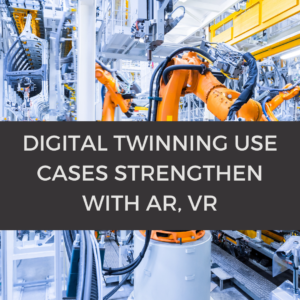
Digital twinning use cases strengthen with AR, VR

In a nutshell, digital twinning is the process of creating a highly realistic model of a device, system, process or product to use for development, testing and validation. Augmented reality (AR) and virtual reality (VR) come into play as well. For example, AR can show a digital twin on top of a physical machine and provide information a technician wouldn’t otherwise see, and technologists can enter the VR of a digital twin to simulate various issues.

Many folks associate the use of digital twins solely with manufacturing. While it is true that manufacturing has pioneered the use of digital twinning, use cases exist in every industry. Additionally, there are digital twinning use cases in cross-industry applications such as infrastructure and automation.

To better understand the potential uses of digital twinning, AR and VR, take a look at the use cases in a handful of industries.

Manufacturing

Aerospace, automotive and general-purpose manufacturing firms use digital twins as part of overall product development. Here are some common uses:

  • creating design mock-ups to show how a finished product will work;
  • fine-tuning product features and capabilities;
  • defining requirements to provide guidance to component suppliers on component specifications, such as bolt size, shape and strength;
  • testing and quality assurance;
  • creating customer-requested modifications and other design personalization;
  • creating operational and performance optimization; and
  • predicting future failure modes so maintenance can be preemptively scheduled, and executing on other predictive maintenance goals.

Healthcare, retail and other human-centric industries

Companies that interact with customers can also benefit from digital twinning, which enables them to optimize patient care and customer service. Some examples include the following:

  • improving operational efficiency, such as using digital twinning to optimize the flow of patients or customers through a facility;
  • improving user experience by using AR and VR focus groups to test how customers or patients experience a physical facility;
  • improving layout and design of facilities; and
  • refining products and services for optimal appeal to customers and patients.
  • Supply chain and logistics industry
  • Companies that are heavily reliant on their supply chain or logistics functions can see particular benefits from digital twinning. Examples include the following:
  • pre-testing the performance of packaging and packaging materials;
  • optimizing routes and delivery processes; and
  • improving handoffs between stages in a supply chain.

General applications of digital twins, AR and VR

One often-overlooked use case for digital twins, AR and VR applies to almost every industry: infrastructure performance and automation.

Digital twins of routers, servers, storage appliances and virtual machines can serve as testing grounds to explore performance or security vulnerabilities. The same goes for testing automated processes.

For example, let’s say an organization is rolling out a new automated process for operating system updates and patch management for infrastructure devices. Network engineers can program the automation tool to roll out the update process on the twinned environment first. In this way, they can gather configuration and performance data and share that with technology operations specialists who can revise the process if it results in unforeseen impacts.

Facilities and technology professionals can also use digital twinning to model the physical environments of systems and appliances. For example, if an organization is building out its own data center, a digital twin can model power, heating and cooling systems against rack layout. Facilities professionals can use this to check for hot spots and make sure that all control panels are easily accessible by facility personnel.

While it is true that manufacturing has pioneered the use of digital twinning, use cases exist in every industry.

Finally, organizations can use the digital twin to optimize human operational processes, such as mapping how technicians walk through the data center.

While these applications may seem futuristic, enterprise organizations are deploying them today. The infrastructure lead at a large financial services firm recently told Nemertes Research that the single most important initiative infrastructure engineers can engage in is implementing AR/VR and digital twinning in their infrastructure environments and automation testing.

A digital twin checklist for infrastructure automation

For enterprise technologists looking to get started with infrastructure digital twinning, what are the next steps? The outline below refers to a network digital twin, but the same recommendations can apply to other infrastructure components such as servers, VMs or containers and storage appliances.

Virtualize and automate all changes to the production network; that is, make sure that all changes to the production network happen through scripts and APIs. Stakeholders should allow no manual configuration.

Using this automation, capture all network configurations in a version-controlled repository, such as Git.

Use a tool like Jenkins to develop and deploy a continuous integration/continuous delivery process and workflow that includes forking the repository, proposing changes and having the tool pull down modifications. This creates scripts to implement the changes on the digital twin network, which consists of the configurations in the version-controlled repository. This involves pushing the changes out, testing that the changes are successful and notifying the network engineer that the changes are successful.

Using Jenkins’ capability, merge the repository and implement the changes on the production network.

Review and sign off on the final state — or, if needed, roll back the changes.

Consider conducting predictive maintenance on the digital twin network regularly to get early warning of any performance, security or other concerns. Where appropriate, deploy proactive patching and upgrades.


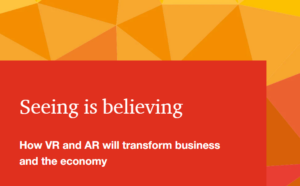
Seeing is Believing by PwC – How VR and AR will transform business and the economy

PwC’s ‘Seeing is believing’ report explores how virtual reality (VR) and augmented reality (AR) may add value to the economy by 2030 as well as the benefits it may bring to industries including manufacturing, healthcare, energy, retail and training and development.

Their findings forecasts that virtual reality and augmented reality (AR) have the potential to add $1.5 trillion to the global economy by 2030.  From creating new customer experiences to speeding up product development, VR and AR can present a broad range of opportunities for businesses.

PwC’s report is enhanced with augmented reality experiences which will provide you with additional insights.  You can visit the PwC website to download your own copy and find out the results of their report, detailing how VR and AR are transforming business and the economy.

Go to: Seeing is Believing 

Also from the PwC website:

We estimate virtual reality (VR) and augmented reality (AR) can bring net economic benefits of $1.5 trillion by 2030. But where did we get that number from? As you can imagine, estimating the potential impacts of new technologies like VR and AR is tricky and uncertain. The task is even more difficult when these technologies are expected to develop rapidly and become more deeply ingrained in our everyday lives. But we feel it’s important to highlight the potential in a way that give our clients the facts to build a business case to act – and that starts with a robust methodology.


As the Metaverse & AR Mature, Will They Fall Into Tech’s Common Silos

As the world of AR and the Metaverse matures, the ability for software and hardware products to integrate with one another becomes a huge factor in the adoption and use of these technologies.

Dan chats with Christine Perey, the founder and principal analyst of Perey Research & Consulting and founder of The AREA, on how history reflects tech’s tendency to embrace operational and hardware silos, and why siloed products cause significant inefficiencies and increase cost.

Abridged Thoughts:

“[Interoperability in the AR world] is the ability for components, software, hardware, services from any vendor, to be able to exchange data without the user needing to concern themselves with who made that part, and so it’s the ability for multiple vendors to combine parts and their customers also to be able to combine parts into new and unique ways and come up with new, innovative solutions that solve a specific problem.

And so the interoperability also allows the market to go to scale because you’re no longer going to be focusing only on one use case or only on one component of the whole system. You can take your component into many, many different pieces of hardware, for example, something I know a lot about, or software; you could take your content and deliver it on any browser, any player.”

– Christine Perey 


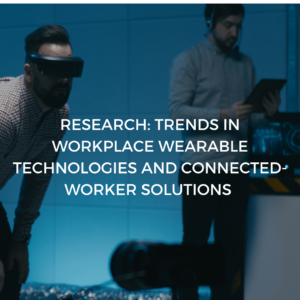
Research: Trends in Workplace Wearable Technologies and Connected-Worker Solutions for Next-Generation Occupational Safety, Health, and Productivity

The workplace influences the safety, health, and productivity of workers at multiple levels. To protect and promote total worker health, smart hardware, and software tools have emerged for the identification, elimination, substitution, and control of occupational hazards.

Wearable devices enable constant monitoring of individual workers and the environment, whereas connected worker solutions provide contextual information and decision support. Here, the recent trends in commercial workplace technologies to monitor and manage occupational risks, injuries, accidents, and diseases are reviewed.

Workplace safety wearables for safe lifting, ergonomics, hazard identification, sleep monitoring, fatigue management, and heat and cold stress are discussed. Examples of workplace productivity wearables for asset tracking, augmented reality, gesture and motion control, brain wave sensing, and work stress management are given.

Workplace health wearables designed for work-related musculoskeletal disorders, functional movement disorders, respiratory hazards, cardiovascular health, outdoor sun exposure, and continuous glucose monitoring are shown. Connected worker platforms are discussed with information about the architecture, system modules, intelligent operations, and industry applications.

Predictive analytics provide contextual information about occupational safety risks, resource allocation, equipment failure, and predictive maintenance. Altogether, these examples highlight the ground-level benefits of real-time visibility about frontline workers, work environment, distributed assets, workforce efficiency, and safety compliance.


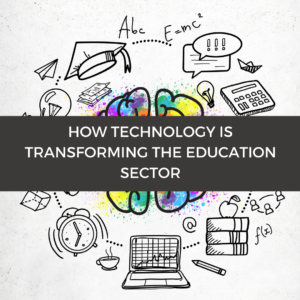
How Technology Is Transforming The Education Sector

With the advent of technological innovations across industries, the education sector turns out to be the most influenced. In-fact, technology has been playing a prominent role at the forefront of education ever since learning and development came into being, right from carving symbols and figures on walls of caves, to Gurukul education where the students were taught the use of the technology prevailing then, to using of artificial intelligence (AI) and virtual reality (VR).

Modern technology has completely reshaped the entire education system. The digitally empowered classrooms over the internet have made education available to each and everyone who wants to learn across the world, anytime, any subject and anywhere. There is no limit to the strength of the classroom. Unlike physical classrooms that are limited to a maximum of sixty students, any number of students can access the virtual classrooms. When it comes to learning, there is an unlimited amount of knowledge available at no cost to an economically viable price.

Interestingly, according to Wikipedia, YouTube has more than seventy lakhs of educational videos, and besides, there are a lot of other educational websites that have various knowledge-sharing pages provided by respected subject experts in every field.

The effect of technology on the students

Not long ago, education was pertained to the reading of books and listening to teachers which were boring to many students and tiresome to teachers. Some educational institutes tried to introduce activity-based education which of course motivated the students and increased the interest level to a certain extend, but the effect was not as expected.

The education using modern technology like Augmented Reality, Virtual Reality and Artificial Intelligence has made learning more collaborative and engaging. An article by Schindler et al., 2017  states that Technological application in education engages the student to involve in high-order thinking, develop communication and discussion, and reflect on the gist of the content. It also enhances digital competency. Another research established that the implementation of technology in the classroom has enhanced the motivation of the student to understand and accomplish the tasks (Mistler-Jackson & Songer, 2000).

Undoubtedly, technology increased the interest in learning by many folds and modern technology helped the student improve their critical thinking and analytical skills which is very much necessary to face any kind of challenge. It has not only helped the students to become successful but also to excel. This is not only for schools but also for higher and professional studies.

Traditional teaching versus Virtual teaching

Marc Prensky [Educational Author 2001] noticed that an average student spends less than five thousand hours reading in his entire life but more than ten thousand hours playing digital and online games. He also stated that the students of the present are no longer the ones our traditional education system was designed to teach.

Other researchers such as Pucel and Stertz [2005], Crowe [2004], Lu and Gordon [2009], have recognized that technological education method is needed than traditional education.  The National School Boards Association [2007] recognized technological proficiency as an essential learning tool of the twenty-first century. A remarkable statement of John Dewey “If we teach today’s students as we taught yesterday’s we rob them of tomorrow” (Agnello, White, & Fryer, 2006) sums up the importance of technology in the education system.

Challenges in implementing technology in the schools and collages

Jung pointed out the challenges, the traditional classroom teachers have to face due to rapid shift and use of technological methods in the classroom and about the expansion of the knowledge base available. Gressard and Loyd (1985) said that the attitude of teachers towards technology and technical gadgets is the main factor in implementing Information technology in the education system. They also pointed that not all teachers are keen on technological methods.

Another point is that they have to be trained to upgrade themselves to be in line with upcoming technology. Most of the teachers from GenX feel that it is hard to learn the complicated technology and blackboards are much simple. They believe classroom education involves emotional binding that helps in being good humans. The teachers of millennials though not new to technology are busy and lack time to upgrade themselves. The other barriers are lack of resources, limited or no access, low expertise, limited support and lack of time. Butler and Sellbom (2002) and Chizmar & Williams (2001) stress reliability and hardware compatibility and internet issues. Technology is growing at an exponentially faster phase which means a gadget bought today may become less useful or not at all in three months. Upgrading those needs money, time and expertise.

Many believe that technology in the education sector would make students more attached to machines and less socially able. We can see that the children of iGen spend more time with cell phones and other gadgets. Even a baby less than a year becomes calm and is more attracted to the cell phone display. Studies are going on as to how it would affect the brain but for now, artificially intelligent machines are in a major role.

The good part is kids get easily adapted to technology. Software programming is becoming the favorite subject for kids these days. They could learn, analyze and create a software program even before they turn into teens. This proves that the brain is slowly evolving from its present state to a higher state of understanding machine language. There are also a lot of social groups online related to every field where the students interact with others with the same mindset. Group discussions and knowledge-sharing blogs are increasing so it is not fully right to say that society is becoming less socially able. It is only that the medium of communication has taken a different platform.

A good learning technological media can be something that is easily accessible in any place. It should be easy to use by an average person with limited knowledge of computers. It should be highly interactive, fun and work on low bandwidth and should not take lots of time to load, and should be able to upgrade itself from time to time.