Augmentir Highlighted in Gartner Hype Cycle for Frontline Worker Technologies, 2020

This Hype Cycle highlights several key mature and emerging technologies that are focused on helping frontline worker productivity, including the following:

  • Remote Expert Guidance Solutions: Remote expert guidance solutions provide industrial-level collaboration between subject matter experts and remote workers or customers utilizing mobile or wearable devices. Typical features include chat, live video, file sharing, and annotations, which provide visual cues that overlay the worker’s view. These tools help guide remote workers as they perform tasks, and are used across a variety of use cases – maintenance and repair procedures, remote factory acceptance tests, post-task audits, or training.
  • Connected Factory Worker: Connected factory workers use various digital tools to improve the safety, quality, and productivity of the jobs they perform. This technology helps connect workers to the “digital fabric” of the business, providing insight into the tasks they perform so that they can be optimized and continually improved on.
  • Augmented Reality and Mixed Reality (AR/MR): Connected workers use augmented and mixed reality technologies to improve and integrate their interactions with both physical and virtual surroundings. Through the use of digital work instructions, as well as augmented/mixed reality delivered through mobile and wearable devices, they are able to make faster and better decisions that optimize and improve a process or workflow that they participate in.

Augmentir’s Approach to the Connected Frontline Worker

Augmentir sits on the intersection of these innovation profiles, using artificial intelligence and machine learning (AI/ML) to amplify the value that digital technologies bring to the connected worker.

Augmented Work Instructions and digitized workflows help guide connected workers with visual aids while AI-driven insights provide contextual information that enable workers to perform at their best.

Remote Expert Guidance helps companies virtually connect and collaborate with their frontline workforce and their customers to provide remote guidance and support.

AI-based Operational Insights help companies identify the largest opportunities in improving the skills of the frontline workforce, and helps to drive continuous improvement throughout the organization.

At Augmentir, our AI identifies patterns and generates insights based on analyzing data from connected workers. These insights improve worker performance as well as provide positive impact on training, operational workflows, and quality. According to Gartner, “The possibility of predicting performance is extremely attractive for manufacturers. This is driving the strong interest in ML. ML is an essential enabler of artificial intelligence (AI), smart factories and intelligent automation.”

Our view at Augmentir is that the purpose of a connected worker platform isn’t simply to deliver instructions and remote support to a frontline worker, but rather to continually optimize the performance of the connected worker ecosystem. Artificial intelligence is uniquely able to address the fundamental macrotrends of skills variability and the loss of tribal knowledge in the workforce. With an ecosystem of content authors, frontline workers, subject matter experts, operations managers, continuous improvement engineers, and quality specialists, there are dozens of opportunities to improve performance.

If you’d like to see how our AI-Powered Connected Worker platform improves safety, quality, and productivity across your workforce, schedule a demo with one of our product experts.


AR, AI and IIoT empower Front Line teams

The technologies underpinning the Industrial Internet of Things (IIoT) are key to the success of Industry 4.0. I recently had the honor of hosting a panel during IIoT World Days virtual conference looking at the role and power of analytics in IIoT.

Each of the five guests on the panel had insights into what they called the “Manufacturing Analytics Journey” – taking a detailed look at how analytics impacts profitability, powers prediction, informs intelligent optimization and leverages big data.

The insights they offered about the importance of data and analytics got me to thinking about the important role that AR, AI and mobile devices can play in actually making use of that data on the front line.

As it happens, integration with industrial IIoT infrastructures is something that our team has spent a great deal of time working on over the last several years. Since the first release of our “Transforming the Enterprise” white paper back in late 2018, we have been clear about the relationship between IIoT, AR and AI.

In the latest release of that White Paper, we spelled out exactly how we saw the connections between AR. AI, IIoT and machine learning. We start with the context of the frontline team member in an industrial setting who is servicing a piece of equipment.

This context could leverage data about:

  • the work identity profile of the frontline team member
  • the skill set data of the frontline team member
  • historical data covering the work instructions they may have previously worked with in relation to a particular piece of equipment they are servicing
  • the remote experts or colleagues they typically work with
  • and what level of certification and training they may have in undertaking the job they’re about to do.

Once we have that foundational context, we can combine it with information about location, time and date (all drawn from the mobile device itself) – and then start using relevant industrial IoT data to provide:

  • very specific assistance that is relevant to the task at hand,
  • insights into how the equipment that the frontline team member is working on may relate to other useful IoT data from similar equipment
  • live diagnostic data from the equipment itself.

We believe that front line teams need to be able to use their mobile devices (including smart glasses, tablets and smartphones) to get information from machines, sensors, and the IIoT infrastructure and see the the data flow into their field of vision.

The IoT data can come from the frontline team member’s immediate work environment – with QR code or object recognition scans being used to perhaps draw information about when a piece of equipment was last serviced, provide immediate access to all relevant service records, work instructions and performance data for the equipment itself.

And the utility of having these technologies linked doesn’t stop there. Context is also a vital component of helping systems become more intelligent (though ML and AI technologies) and predictive.

Leveraging both edge computing and AR technologies, enhanced by machine learning and artificial intelligence, creates a platform that can anticipate what members of the extended enterprise will need to do next – sometimes before they know it themselves.

It builds on the idea that an organization has the capability, with the simple introduction of something like our Front Line OS (powered by AR and AI), to hold up a mirror to itself – and its supply chain – to gain true predictive insight in both the specific and broad collaborations of the extended enterprise.


Daimler Transforms the Automotive Lifecycle

The division uses Unity to create a mixed reality pipeline connected to systems and Product Lifecycle Management (PLM) data, then deploy applications to multiple platforms, including Microsoft HoloLens, Oculus devices, and smartphones.

This blog details a few of the ways in which they create and deploy HoloLens applications at various stages of the automotive lifecycle.

Production

Daimler Protics uses Unity for a variety of use cases in the production phase, from planning factory layouts (e.g., previsualizing machinery and architecture) to assembly training (e.g., training workers on how to assemble the cars). Safety inspection is one of them (see video above).

Automakers often use robotic laser welding to precisely and efficiently fuse various parts of the vehicle together. When Daimler’s robot cell is in operation, however, the space is closed off to prevent anyone from looking inside and losing their sight, making safety inspections difficult.

The team developed an application that replays each robot’s logged movements on the HoloLens once a session is complete. This application displays predefined safety spaces, so it’s easy to verify whether the robot’s movements have adhered to safety protocols.

Sales and marketing

Mercedes-Benz formed the EQ brand for its new fleet of electric vehicles. For the Mercedes-Benz EQC, the automaker’s first fully-electric compact luxury SUV, the Daimler Protics team created a HoloLens experience to help drivers better understand the inner workings of an electric vehicle compared to the gas-powered versions to which they’re accustomed.

Designed for auto shows and dealership showrooms, the self-serve application guides users – the vast majority of whom have never used a mixed reality headset – showing them where to look and identifying various points of interest as they walk around the vehicle. Daimler’s goal is to tell a rich, interactive story about the Mercedes-Benz EQC, including the location of the battery powering the vehicle, and how it works and charges.

After-sales: Maintenance and repair

Traditional training programs use cut-section models to instruct technicians on how to service an automotive transmission. While working on a full-scale physical model is helpful for understanding, the educational value of a cutaway version that’s disconnected from the car is limited.

Daimler Protics solved this dilemma using mixed reality. The application not only surfaces the transmission’s various hard-to-see components, it also makes it easy to replicate the experience of the running engine, and visualize how it changes when shifting gears or braking.

Read the original article here.


Enterprise AR Trends for 2020 and Beyond

What Is the Impact of Enterprise AR on the Business World?

AR has penetrated almost all the industries: automotive, professional services, education and training, retail, architecture, and healthcare. These are just a few core industries where professionals from junior to senior levels are working with AR tools.

Thus, it is worth looking at short-term and medium-term enterprise AR trends, to see where the business and professional world is heading and how the workplace will be transformed.

Here are some of the most important enterprise AR trends for the next few years:

1. AR Becomes the Norm for Frontline Workers

Workers are used to handling various tools and pieces of equipment in order to perform their tasks. These tasks cover manufacturing, maintenance, and troubleshooting and operating various industrial machines.

Very soon, AR headsets will become a regular tool for all these workers. As proven by various companies, augmented reality is an excellent medium for displaying instructions, offering expert support, and reinforcing safety rules.

2. AR Hardware Will Become Better, More Affordable and More Comfortable

This is one of the enterprise AR trends that everyone will profit from. As augmented reality is becoming more pervasive in all industries, hardware producers will come up with new, improved models of AR glasses. These new models will be more affordable, lightweight and easy to use, as well as more powerful, with improved performance.

Already, several top-level companies like LG, Apple, and Sony are joining the market of AR hardware producers, dominated so far by Microsoft and Magic Leap. This increased level of competition is healthy for the industry, not only for enterprise AR but also for consumer products.

3. One of the Ongoing Enterprise AR Trends: Retail Transformation

Consumers love AR as part of their shopping experience. Also, developers are constantly working on improving facial recognition, latency, and other factors to make product try-on more realistic.

As the last few months demonstrated, AR capabilities embedded in shopping apps and websites have kept sales going, even under difficult conditions. Thus, consumers will soon expect all fashion, cosmetics, furniture and home improvement brands to let them experiment with virtual objects before purchasing products.

4. Increased Mobility and Collaboration

Among other enterprise AR trends, this will be most beneficial in a post-COVID world. Through collaborative tools that allow object manipulation and editing, teams can work together without sharing a physical space.

With many employees still working from home, the possibilities offered by cloud AR services are endless. They will allow business to go on while people stay safe and comply with social distancing rules. At the same time, it will allow businesses to work with international clients and expand their market.

5. Enterprise AR Software Will Be More Specialized and Customized

Companies have understood that AR offers a competitive edge if it is implemented and used correctly. Thus, they are no longer satisfied with ready-made solutions. Developers will have the task to create highly specialized and customized solutions.

These solutions will serve each specific industry and meet the demands of corporations in terms of data protection, business processes, and specific work procedures. This is one of the enterprise AR trends that will continue over the year and differentiate top players from the rest of their competitors.

See original article on AR post. Enterprise AR Trends for 2020 and Beyond


First knee replacement surgery successfully completed with Augmented Reality Technology

Pixee anticipates the number of total knee replacement cases using the Knee+ technology will increase quickly as they already have a sizable list of surgeons interested in trying this innovation using the Vuzix M400 Smart Glasses. The combination is compact, easy to use, wireless and does not require disposables.

Pixee Medical expects to sign their first distribution agreements with implant manufacturers over the next few weeks, allowing their solution built around the Vuzix M400 Smart Glasses to be promoted by them worldwide. Pixee Medical is pursuing and expecting FDA approval (510k) for Knee+ before the end of 2020.

“The team at Pixee Medical created an innovative path to bring the Vuzix M400 Smart Glasses into the operating room to perform knee replacement surgeries and we look forward to supporting the worldwide distribution of their innovative AR solution,” said Paul Travers, President and Chief Executive Officer at Vuzix.

Read more in the full press release


From Surviving to Thriving: XR Helps Enterprises Stay Cutting-edge, beyond COVID-19

To maintain operations and keep employees safe in the ongoing pandemic, more and more businesses are turning to augmented and virtual reality (AR/VR or XR), particularly XR remote support, training and collaboration solutions. A big step up from familiar video conferencing solutions like Zoom, AR/VR allows teams to effectively collaborate, train, and deliver services from a distance. (Basically, you don’t have to completely cease operations.)

In a lot of cases (as you’ll read below), the pandemic ‘simply’ pressed fast forward on companies’ existing AR/VR plans. Though there were plenty of case studies demonstrating the benefits of immersive tech at work pre-pandemic (not to mention the first rollouts at large companies), we were likely several years away from widespread daily use of these tools in enterprise. Thanks to the virus, what was expected to take five to ten years occurred in a matter of weeks or months—an incredible transformation when you think about it. Microsoft has seen a 13-fold increase in remote assist on HoloLens 2 since January, while other AR/VR solution providers have been offering their products and services for free to assist small businesses. The following are a sample of forward-thinking companies using XR ‘on the daily’ during quarantine:

Genesis Energy

Two years ago, the New Zealand-based electricity and gas supplier purchased a basic HoloLens kit in hopes of using the device to perform tasks typically carried out in person by local and overseas experts. Unfortunately, the technology didn’t stick then. Fast forward a few years to when coronavirus convinced the company to revisit HoloLens in an effort to keep several major engineering projects on track. Now, Genesis is using the technology multiple times per week and will continue to do so beyond the pandemic to cut down on engineers’ travel. 

To perform remote/hands-free inspections and even virtual certifications, an on-site engineer wearing HoloLens shows aspects of a project to different experts. Genesis is also eyeing the mixed reality headset for training, to help fabricate replacement parts for machinery no longer produced and to capture (i.e. record) older engineers’ institutional knowledge.


Lowe’s

Since 2016, Lowe’s has delivered XR apps to help customers measure rooms at home, locate products in store, and even virtually practice home improvement projects. For the quarantine, the home improvement chain launched Lowe’s for Pros JobSIGHT powered by Streem, an AR video chat solution allowing Pros to conduct virtual home visits with homeowners and clients. These contact-free consultations are critical, as homes are no longer just ‘where the heart is’ but also serving as work offices. Pros can troubleshoot issues, using an on-screen laser pointer and AR ‘quick-draw’ to guide customers through the consultation or a simple repair.   


Ford

The automobile giant was already using virtual reality in vehicle design; the virus, however, took the technology from the office into employees’ homes, enabling Ford designers to finish up development on the Ford Mustang Mach-E and begin work on a brand-new car from home. Represented as avatars with emotive movements and voice, Ford’s designers can review CAD-generated models of in-development vehicles ‘together’ in a virtual studio. Though VR won’t replace clay modeling (at least not yet), Ford has been researching technologies and tools like haptics and Gravity Sketch to imbue digital work with some of that same hands-on physicality. 


BNP Paribas Real Estate / Cornell

Conscious of the cost and carbon footprint of constant overseas flights, the BNP Paribas subsidiary was already using Spatial pre-pandemic to broker corporate deals across the world. Agents’ work has continued despite stay-at-home orders thanks to the VR meeting solution, which allows them and their clients to manipulate and walk through 3D models of properties. At Cornell’s med school, clinicians are also using Spatial, wrapping HoloLens 2 and Magic Leap One headsets in PPE in order to connect with remote colleagues during rounds (thereby limiting exposure).


AWL

This Netherlands-based system integrator specializes in joining technology. As some of its machines are made to order, customers would often travel to AWL in Harderwijk to perform Factory Acceptance Tests (FATs). When the pandemic hit, AWL worked with Recreate Solutions to take this process virtual. Using HoloLens and Microsoft Remote Assist, customers can connect to an AWL representative who can, in turn, share design documents and place 3D annotations in the customers’ world to guide them through machine delivery and service requests.


Cox Communications

Broadband Internet provider Cox Communications considered using AR in customer service before this year. What the pandemic did was add urgency and so in March, Cox rolled out AR to its 5,000-strong workforce, including home technicians and contractors.  

Facebook

If you needed a sign that remote work is the future and not just a condition imposed by a global pandemic, this is it: Facebook recently announced it will allow employees to request permanent remote status and will open up new roles to remote workers. The company’s Head of AR and VR also teased a vision of remote work, an eight-second video of a prototype augmented workspace with both AR and VR features and both new and everyday inputs. It appears the social media giant is accelerating work on passthrough, hand tracking, realistic avatars, spatial audio and more during Covid to meet this vision of the future of work.


Garvey Corp

Pre-pandemic, family-owned Garvey Corp had weekly ‘virtual’ meetings, sharing pictures and video from the plant with people off-site. Factory Acceptance Tests, however, were performed in-person by the customer. When COVID was declared a pandemic, Garvey remained open, but customers could no longer come in to inspect equipment before having it shipped to their factory. The New Jersey manufacturer began offering virtual FATs (essentially video conferencing) as well as augmented reality to enable Garvey service techs to see into a customer’s factory and guide them through a machine modification.


CNH Industrial

CNH is one of the world’s largest capital goods companies. One of its brands, New Holland, has been using Librestream’s Onsight AR solution to deliver continuous support to its large dealership network during quarantine. Using live audio and video, digital images, and drawn cues viewed through the customer’s mobile device, New Holland’s remote experts have been able to keep customers’ operations running throughout the pandemic. AR plays a role in commercial sales, too, enabling dealers to do virtual walkthroughs with a New Holland expert before taking a new piece of equipment into the field.


Electrolux

In light of social distancing and since many of its customers are considered essential, Electrolux fast-tracked the launch of its mobile AR remote guidance app “Two Pairs of Eyes.” The app provides remote, contact-free support to customers with Electrolux professional food service equipment. Electrolux technicians can guide customers through basic servicing and MRO tasks, in addition to providing remote training and product tutorials. Electrolux has found that problems are being solved 30% faster with the app compared to regular video calls, and with 50% fewer errors.


Conclusion

Remote work via AR/VR is more than viable. While XR was ‘nice’ and innovative to have or test as a company before coronavirus, the technology has become vital during the pandemic. The next question is what will the return to ‘business as usual’ look like? Will the rush to go remote stop? Will we ever fully return to pre-covid working conditions or will these remote AR/VR solutions last, enabling portions of the workforce to continue working from home?


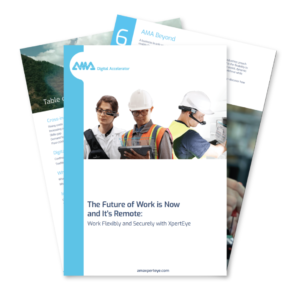
Free white paper Work Flexibly and Securely with XpertEye

Download this free white paper to learn:

  • The trends and challenges making digital transformation essential across industries, including rising costs, a looming $8.5 trillion global talent shortage, and a world-altering pandemic
  • Why traditional telepresence and video conferencing solutions are limiting in cost, mobility, data exchange, and data security
  • How AR remote support is helping companies to respond faster, reduce travel, save money, upskill workers, and deliver seamless service by enabling the on-site worker and a remote expert to share the same view
  • What makes XpertEye stand out among remote assistance solutions (device agnostic, security, transparent pricing, etc.)
  • Applications and real use cases for XpertEye in Oil & Gas, Manufacturing, and more

Click here to download your free copy.


Virtual Reality and Augmented Reality in Learning and Training: overhyped or new industry standard?

How Can VR Change the Training Industry?

Let’s take a look at how VR will affect the 70:20:10 model of learning. We know that classroom and e-learning modules only account for 10 percent of learning. Seventy percent of learning comes from tackling real-world tasks and problems. The other 20 percent comes from social learning via observation of others and feedback.
But what if learners could receive on-the-job experiences without actually being on the job? VR promises to do just that via a simulated environment.

Within the simulated environment, the learner must make on-the-spot decisions and respond to real-time stimuli. For example, learners in law enforcement will feel their hearts pound and their palms sweat during simulated live shooter scenarios. Your employees will stress over making the best possible decisions for your business by de-escalating angry customers or having difficult employee conversations. Even though it looks like a video game, it isn’t. It’s not about saving the world anymore, it’s about saving you money with the best trained talent. No other training medium can invoke authentic emotional responses like VR.

Is AR Just As Effective As VR?

Many of us have already experienced a primitive form of AR through Alexa or Google Home. Voice-activated tools augment our daily conversations by making the internet a conversation partner.

But AR is much more than voice commands. It can also superimpose virtual images onto the physical world. This augmented experience allows people to make different decisions. If we include chatbots, AR could provide a unique learning experience guided by a computer. It would be GPS navigation for learners.

Unlike VR, AR has already begun to change the daily practice of some professions. The FDA approved Opensight, a Microsoft AR-enhanced medical imaging product, which allows clinicians to overlay scans onto the patient and interact with the data in 3D. Similarly, Tradiebot developed an AR app for car mechanics that overlays the repair steps onto the physical car, then guides the mechanic through the repair. These innovations represent game-changing performance supports for certain professions.

Is the L&D Industry Adopting AR/VR Technology Right Now?

The 2019 Training Industry Report surveyed 240 U.S.-based education and training organizations. Here’s what they discovered about American AR/VR adoption:

15 percent of all organizations plan to invest in AR/VR technology.

1.6 percent of training is delivered with AR.

1.9 percent of training is delivered with VR.

23 percent of large companies use VR, and 11 percent use AR.

Less than 5 percent of small or mid-sized companies use VR, AR or AI.

As a whole, the industry is not seeing a rapid adoption of VR or AR. One widely used technological adoption model by sociologist Everett M. Roger suggests 5 phases of adoption: Innovators (2.5 percent), early adopters (13.5 percent), early majority (34 percent), late majority (34 percent) and laggards (16 percent). Currently, only innovators are using VR/AR.

However, if we only look at large companies, then the adoption picture changes. They appear to be entering the early adoption phase with 23 percent of them using the new technology. As the cost of AR/VR continues to fall, I predict more companies will adopt it.

Where does VR training give business the biggest boost?

Virtual reality training comes out of the educational method called “simulated training.” The aviation industry began using simulated training as early as 1929. They’ve continued to use simulated pilot training because the cost of fueling an airplane is still greater than the cost of an expensive simulation.

Like the aviation industry, educational institutions have been quick to adopt VR. Many schools and colleges cannot afford expensive laboratories. Virtual science labs provide a way for students to gain valuable laboratory experience without investing in high-tech lab equipment or materials.

For some industries, simulations allow employees to experience dangerous situations without actually endangering them. Construction workers can make dangerous errors in a virtual environment. Similarly, law enforcement officers can de-escalate life-threatening situations or react to emergencies virtually. Unlike a textbook, the simulated experience forces trainees to grapple with their own fears and emotional responses. Then, they won’t be panicking in a real-life emergency.

VR also represents an opportunity to quickly train medical professionals on new instruments or complex, new procedures. They can practice first using virtual instruments before performing the procedure on a live patient. Today, up to 30 percent of general surgeons are not yet ready to work independently at the end of their residency. VR training might help fill the gap for new surgeons.

Finally, large companies have begun to use VR for less dangerous, expensive or life-threatening skills. However, these skills still benefit from life experience. Walmart has created a VR Black Friday simulator to prepare their retail employees for the shopping holiday. Other companies have started to use VR to onboard employees by allowing them to experience their first day via VR before actually starting their job roles to reduce anxiety. Some of these skills, such as soft skills training, can be bought ready-made off the shelf.

Truly, the sky is probably the limit for the applicability of simulated training. That’s why I’m betting VR will eventually be a standard part of training like videos are today.

How do companies use AR now?

AR, unlike VR, requires the real world. AR simply enhances the real world experience.

The best example of AR in action are performance supports or job aids. Traditionally, when employees seldom used a process they would look at a laminated job aid. Today, with search navigation, we look it up. AR would take our walkthrough videos one step further by providing voice instructions and a virtual overlay to help guide us through the process.

What about processes employees do constantly? Can AR also improve them?

Research from the WHO on safe surgeries suggests using checklists improves surgical safety. AR could help perform safety checks in a variety of industries, such as general maintenance checks for machinery or safety awareness in warehouses.

AR also promises to engage learners during traditional coursework. Like Alexa or Google Home, learners could access more information to support personalized learning. They could also receive instant feedback by turning AR on to check their work. This feature could provide automated, scalable feedback to hands-on professionals in construction or manufacturing where assessing hands-on projects without expending a large number of resources presents a huge challenge. Voice-enabled AR could also lead learners through a process, even something as simple as onboarding.

Ultimately, this technology promises to improve the user-experience.

What do we need going forward for widespread AR/VR adoption?

Currently, AR/VR training tools need to be custom built by a firm or bought off the shelf. To be truly effective, companies need content authoring tools. Right now, instructional designers use tools like Articulate Storyline and Adobe Captivate. In the future, they’ll need tools for AR/VR.

Virtual and augmented reality have not seen wide public buy-in. VR headsets and AR glasses remain toys. Wider public adoption will facilitate wider adoption in the training industry, too.

From a design perspective, the headsets may also need to become more comfortable so workers like doctors or mechanics can use them for hours at a time. Prices for VR headsets and AR glasses also remain high.

Since only 1 percent of small-medium size businesses invest in VR training today, I expect we’ll see greater investment by these companies when prices drop. Given the return on investment for VR training, Josh Bersin suggests businesses focus first on the skills and competencies driving their core business. When trying to determine business-critical operations, I suggest small-midsize businesses think about where they stand to lose money. For example, manufacturing or construction companies lose money when employee errors create product defects. VR training on how to make those products could create substantial gains. Similarly, closing more sales would generate more revenue so it makes sense to invest in VR training for your sales team.

Should you invest soon?

Like most learning technology the answer is: “It depends.” Technology never offers a silver bullet. It’s a tool for your L&D team.

AWE Online 2020

The following partners were in support of the massive global event and you can see them here.  Partner logos were shown on rotating slides in each livestream:

From the AREA a big thank you to Emily Friedman who has organized and promoted AWE and now moves on to other projects with BrainXChange, an AREA member. We wish Emily all the best with all that BrainXChange has planned.


AWE in the News

Hear what the press had to say about the event: Highlighted coverage:

AR Post

Auganix

USA TODAY

VR World Tech

Forbes

Catch up on all the major announcements made at AWE Online 2020: Day 1, Day 2, and Day 3. Check out who won the 11th Annual Auggie Awards, plus the Nextant Awards presented by Virtual World Society.

AWE on Social

Catch up on what Twitter had to say using the official hashtag #AWE2020.


Reflekt speaks to William Harding on how AR Transforms medical device manufacturing at Medtronic

What is the real potential of innovative technologies like Extended Reality (XR) in the medical sector? Where are solutions already adding value and cutting costs? And why is XR technology the transformative approach medical manufacturers have been waiting for?

Wspoke to William Harding, who is a Distinguished Technical Fellow at Medtronicto get first-hand insights on how XR technology makes a difference in manufacturing, by simplifying operator training. He shares what challenges a medical device manufacturer must overcome to establish lean production processes and deliver high-quality products.

William is doing research on technology integration within Medtronic and leading the implementation of AR solutions at Medtronic’s facilities in Tempe, Arizona and Santa Clara, California.

RE’FLEKT: “What are some of today’s key challenges in the medical sector?” 

William Harding (WH): “There are three major challenges that can be identified in the context of technology. First of all, we see an increased risk of human error due to a lack of training, which is itself due to the high rate at which innovative medical device technology is evolving. Secondly, there is a lack of technological adoption. Technology used today is often outdated and doesn’t integrate with the latest solutions. And thirdly, we identified an increase in time invested by healthcare professionals to manage medical records instead of taking care of the patient.”

RE’FLEKT: “How can innovative solutions using Mixed Reality (MR) help tackle the challenge of increased human error?”

WH: “For example, we have a set of digital simulators that train doctors to practice minimally invasive surgeries. Instead of practicing on the real patient, we use a hands-on simulator combined with a Microsoft HoloLens for increased vision. We found that doctors who first practiced on the simulator showed an error rate of 15% in the real surgery, compared to an 82% error rate in surgeries performed by doctors who hadn’t been trained on the simulator. That’s an example demonstrating how we can reduce human error in medical practice through better training. 

At Medtronic, we consider healthcare to start with medical device manufacturing. That’s why we create solutions for training our own people to build the most reliable medical devices. This is another area where new technologies, including AR solutions from RE’FLEKT, are helping us to improve processes and reduce human error.”

RE’FLEKT: “In medical device manufacturing, a production line changeover is particularly error prone. What factors play a key role here? “

WH: “In manufacturing we have various stages of manual, semi-automatic, and automatic processes. Those processes must be transferred across many facilities where there is a lack of standardization around the data. If I add a new process to a production line, many questions need to be addressed: How do I get the process to integrate seamlessly (e.g., communication protocols, data aggregation, and data transformation)? How do I accomplish that without using paper-based systems? The goal is to speed up efficiencies and reduce scrap while also reducing human error. When we create a new process in lean manufacturing, we need to establish the most ergonomic way for an operator to perform their tasks within a sterile environment. We also want them to complete these tasks in the most efficient way possible, while delivering a high-quality product. There are many factors to be considered.”

RE’FLEKT: “What approach do you usually take when putting a new production process together, and how has AR changed this approach at Medtronic?”

WH: “To train our operators off the floor, we usually build what we call a ‘Six Sigma cardboard city’. It’s a replica of our real production set-up following the six-sigma approach to lean manufacturing. We use cardboard simply because it would be quite costly to replicate the set-up with real manufacturing equipment. Accordingly, with content creation platforms like REFLEKT ONE, we can now create AR applications that allow operators to learn a new process by walking through engaging training guides on a tablet instead of using our cardboard model.

Recently I created a solution to train operators on a manufacturing process for our Linq II battery bond (an implantable 2 lead EKG data recorder for patients). I made the content available to them online, where they could walk through it themselves and learn how to perform the process using gestures in AR. It’s a very fast and effective way of training because it saves resources and is so close to the real manufacturing environment.”

RE’FLEKT: “In addition to those benefits, what impact does the new AR training have on cost and time you need to invest?”

WH: “It used to take us two and a half weeks to build a cardboard set-up with five process stations. For one training session, we also needed at least eight to ten people off the production floor, who then weren’t engaged in manufacturing products while they were in training. It would cost us about $30,000 for one training effort with the cardboard set-up. We usually require five sessions in total to get everything right, and by the time we decide that everything is ready, we’re making changes five minutes later. 

In contrast, creating AR content to train my colleagues took me less than two hours. They can access it individually whenever required (including in the manufacturing floor cleanroom environment) and we can easily adapt it if changes occur in the set-up.”

Read the rest of the interview here.