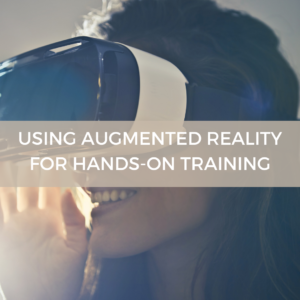
Using Augmented Reality For Hands-On Training
What are the benefits?

Augmented reality provides many benefits for educating and training employees. Visual and hands-on learners may learn more from augmented reality than from a lecture or conference. They can practice as many times as needed without dangerous consequences. In addition, trainees can learn in an interactive environment and feel more inclined to engage.

Employees may feel more willing to work hard if they can sense what they need to learn. AR training provides many training opportunities for them to practice until they perfect their skills. Furthermore, they can complete the training almost anywhere that they can use their AR device.

You can reduce the time trainees spend working with experts. Instead of working directly with clients, they can practice until they feel confident enough to handle the situation in person. In that sense, AR also improves the customer experience. They are more likely to interact with a fully-trained employee, so customer service may run smoother and faster.

Lastly, AR training can decrease training costs. While the equipment is a pricey investment, you can reuse it for all of your trainees. Additionally, most people have smartphones that work with AR training apps.

How do I get started with augmented reality?

If you’re a business leader in an innovation role and are looking at ways to adopt AR in a useful and productive way, there are many considerations to keep in mind when adopting the technology. First, identify the specific use case for AR. There are several ways to implement AR, and each has its merits.

In my opinion, the best-suited option for training is wearable AR. This is where the user’s hands are free as they wear an augmented viewpoint headset. The two main players in this segment are the Microsoft HoloLens or the RealWear HMT-1. Both headsets allow a full range of motion and give the user overlaid information in real-time to assist them during complex tasks or procedures.

Consider your training needs to determine the best solution. Do you need a large field of view (FOV) or the ability to move around easily? Do you want graphical overlays or textual ones? Would it be helpful for trainees to pull data from schematics or instructions and have that information relayed to their eye in AR order to work hands-free? Or do you want them to see an augmented overlay of information in the real world to aid whatever job or task they are training on?

In my experience, the HoloLens is better suited for complex visualizations and works well where there’s a need for high-fidelity graphical overlays. On the flip side, the RealWear HMT-1 is more of an informational diegesis that will aid the worker by supplying additional context, voiceovers, manuals or even diagrams all within a small picture-in-picture viewpoint.

Augmented reality can help employers accelerate training time, educate employees and enhance the workforce by keeping skills relevant. While it is costly to implement, AR can save time and money in the long run because of its efficiency and effectiveness. As more companies integrate AR training into their employment strategies, consider how you can apply it to your business.

When looking to adopt the technology, first consider the use case and then decide on the hardware that would best fit the specific job you are looking to train for. Do your research to build a business case internally to help make a more informed decision.
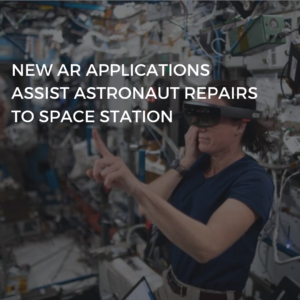



New Augmented Reality Applications Assist Astronaut Repairs To Space Station

The T2 Augmented Reality (T2AR) project demonstrates how station crew members can inspect and maintain scientific and exercise equipment critical to maintaining crew health and achieving research goals without assistance from ground teams.

To kick off the T2AR activities in orbit in April, astronaut Soichi Noguchi of the Japan Aerospace Exploration Agency (JAXA) was tasked with maintenance for one of the space station crew’s pieces of exercise equipment, the T2 Treadmill. The inspection procedure is typically available as a PDF document to be accessed on a computer or tablet, which can be hard to hold while also operating tools or flashlights or examining equipment in a tight space. This time, no extra handheld instructions or communication with ground teams in Mission Control were necessary since the information was all in plain sight. Using the Microsoft HoloLens augmented reality (AR) goggles and armed with novel procedure tracking software NASA developed, Noguchi had step-by-step guidance and cues to assist in the work without referring to a separate screen.

T2AR is the first in-space operational use of the HoloLens in combination with custom-built AR software, which enables an astronaut to perform unassisted maintenance and inspections on a major piece of crew support hardware. This investigation builds on the Sidekick experiment former NASA astronaut Scott Kelly conducted in 2016.

This novel demonstration used 3-D directional cues to direct the astronaut’s gaze to the proper work sites and displayed the procedure instructions. The device followed an astronaut’s verbal instructions to navigate procedures and displayed AR cues and procedure text over the hardware as appropriate for the procedure step being performed. The system also provided supplemental information, such as instructional videos and system overlays, to assist in performing the procedure.

“AR tools hold the promise of allowing us to pre-package guidance and expertise,” says International Space Station associate scientist Bryan Dansberry at Johnson. “The space station is the perfect platform to test out AR systems and refine these tools so they will be ready when future astronauts need them. Closer to home, these tests help to mature software and AR technology now so expertise and support are available in remote locations around the world.”

NASA astronaut and Expedition 65 Flight Engineer Megan McArthur wears the specialized Sidekick headset and tests using augmented reality aboard the International Space Station. Credit: NASA

Since that first activity with Noguchi, astronaut Thomas Pesquet of ESA (European Space Agency) and NASA astronaut Megan McArthur have also used the AR application aboard the space station. The tests provided researchers with information about how the technology does and does not work to assist crew inspection maintenance procedures. With the completion of this maintenance activity, nine more test sessions remain in the technology demonstration plan.

While this demonstration was currently limited to the critical T2 Treadmill, the platform is designed to be used across a wide variety of space station needs in the future, leading to increased crew efficiency and activity execution accuracy. In addition to use on the space station, this technology could aid astronauts on future journeys to the Moon and Mars, when communication delays are greater, by allowing them to conduct tasks without waiting for further direction from Earth.

NASA’s Advanced Exploration Systems division sponsors this technology demonstration aboard the microgravity laboratory to advance future human and robotic exploration missions as part of NASA’s Moon and Mars exploration approach.


Renault Trucks Uses Librestream Onsight to Cut Costs and Boost Commercial Vehicle Uptime

Situation

To maximize uptime of its customers’ heavy trucks and other commercial vehicles, Renault Trucks needed a more effective way to remotely support a network of 72 service outlets across the UK & Ireland. They needed collaborative video technology that would be easy to use, deploy, scale, simplify training and quality control processes, and supply a safe, secure connection even in low bandwidth environments.

Solution

Using Librestream’s Onsight augmented reality software and HMT-1 hands-free headsets from RealWear, Renault Trucks developed Optiview, a remote support platform that has since been deployed throughout the UK and Ireland. The system allows licensed service centers to virtually connect with the OEM’s support desk or even with other service centers.   

Results

Since implementation, there is less need to send Renault Trucks representatives onsite. In-person warranty part inspections have gone down by a factor of five, resulting in 10 to 15% fewer miles driven and a corresponding reduction in greenhouse gases. Warranty claims and payments are much faster, customer satisfaction has improved, and asset uptime is significantly higher—for example, complex service procedures that once took 24 to 48 hours can often be performed in just 20 to 30 minutes, greatly increasing uptime value for vehicle operators 


Read more on Librestream use cases 


TeamViewer Frontline Augmented Reality Certified as SAP Endorsed App Available on SAP® Store

on SAP® Store.

TeamViewer Frontline Augmented Reality provides a unique AR-based software suite for deskless workers using smart glasses or mobile devices. It can be integrated into SAP’s solutions for various industries, enabling SAP customers to digitalize industrial processes and create workflows for logistics picking, assembly, quality assurance and maintenance as well as field service. Moreover, customers can receive AR-based remote support for precise and reliable troubleshooting through a shared camera stream and context-aware AR annotations.

SAP Endorsed Apps are a category of solutions from SAP’s partner ecosystem that help customers become best-run, intelligent enterprises.

Stefan Krauss, SVP & GM Discrete Industries and Energy & Natural Resources at SAP, explains: “With SAP’s recent launch of industry cloud, we simplify access to innovative vertical solutions – built by SAP and our partners on an open platform. AR-based processes can significantly increase productivity, reduce human errors, and machine downtime and therefore decrease costs. We are looking forward to the partnership with TeamViewer to help accelerate digitalization across industries.”

“SAP is a trusted global brand with a proven track record in providing enterprise software. The listing as an SAP Endorsed App gives us the opportunity to jointly go to market and to offer our leading AR solutions portfolio to SAP’s global customer base with the ambition to further digitalize their value chain,” says Alfredo Patron, EVP Business Development at TeamViewer.


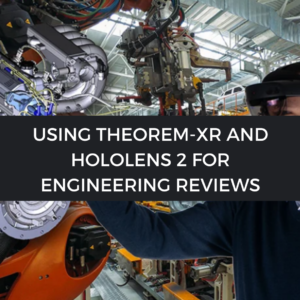
Using Theorem-XR and HoloLens 2 for Engineering Reviews

You can watch the full webinar on Using Theorem-XR and HoloLens 2 for Engineering Reviews.

Key highlights

Theorem has also picked out 5 key benefits of using the Microsoft HoloLens 2 in Engineering which appear in full detail on their blog.

Visualize your models at full scale.
Work collaboratively with other engineers.
Make better factory planning decisions.
Work with large datasets using Azure Remote Rendering.
You can still work with colleagues that are using other XR technologies, or none at all.


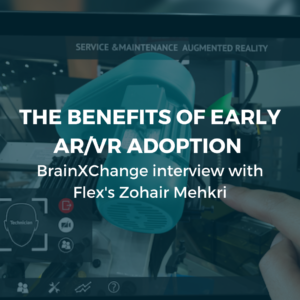
The Benefits of Early AR/VR Adoption Interview with Flex’s Zohair Mehkri

Key summary points from the interview:

AR/VR is one of those technologies that has numerous benefits in manufacturing environments and Flex began utilizing it before a lot of other players entered the market.

Flex currently uses a variety of immersive technologies across its functions. Augmented and virtual reality are used for applications like Remote Assistance, Work Instructions, Logistics, Design Collaboration, Training, and others.

In addition, Flex uses advanced simulation technologies to not only optimize production systems but also immerse users into virtual manufacturing environments with Digital Twins.

It was a big undertaking to start the journey at Flex, and the biggest achievement in the beginning was executive sponsorship and buy-in.

My role was / is worldwide leader and owner of the technology and strategy. The first use case was remote assistance due to the financial benefits and seemingly simpler development. I say seemingly because we quickly learned it wasn’t so easy.

When we started development, we conducted very large-scale market studies and did a lot of collaboration with vendors and suppliers to understand the best path forward.

Our employees at first had mixed reactions and to this day the biggest pain point is the hardware. But as we continue to improve, we’re seeing that acceptance is growing.

To name a few challenges for AR/VR: Hardware maturity, hardware comfort, field of view, battery life, graphics, processing power and UX/UI.

The software had many challenges, as well, including tracking, localization, overlaying, OCR (optical character recognition), object recognition, IDE (integrated development environment) features, and OS compatibility. There are more, of course, but we consider these to be the major ones.

We overcame some of these challenges, mostly in the software space, and for some we had to desperately and quickly find alternatives, especially in the case of hardware. For instance, our hardware strategy ended up shifting to mobile in the beginning due to the lack of wearable hardware that could deliver what we needed.

It was fun introducing AR/VR to Flex’s customers.

The pandemic has had a huge impact; we have seen groups and teams we would never have imagined wanting to use the technology, each with their own needs and requirements.


Tech Talent Set to Showcase Innovative Ideas at Lab by TfW

Lab by Transport for Wales, a scheme developed by TfW and Alt Labs, sees business innovators from across the Wales and Borders region develop their ideas to improve safety, performance, and customers’ experiences on the railway.

Taking place at 1.30pm on Friday 3 September, the virtual demo day gives the businesses from across Wales and the UK the opportunity to showcase their ideas directly to senior TfW innovation managers and industry leaders. The event is also streamed live on YouTube.

It follows a period of dedicated mentoring by business experts both remotely and at TfW’s state-of-the art facility in Newport.


The five companies pitching to TfW on September 3 are:

Jnction – developing Aubin, a new multi-modal journey planner and passenger assistant app which aims to minimise stress for passengers with autism and hidden disabilities when using public transport.

Quinean – developing a low-code machine learning platform that allows domain experts to deploy digital twins, test hypotheses and optimise outcomes at speed.

RoboK – developing efficient AI-based computer vision solutions to democratise safety in transportation.

Stofl – developing infrastructure and solutions that combine Blockchain and Low-Power-WAN technologies, allowing machines to communicate and solve some of the world’s most pressing problems more efficiently, securely and in locations further afield.

Utility AR – work with innovators in industrial sectors to unlock the potential of Augmented Reality applications which allow the user to interact with the real world while accessing existing databases and software systems.

Find out more information here https://businessnewswales.com/tech-talent-set-to-showcase-innovative-ideas-at-lab-by-tfw/


Inpixon and Ostendo Announce Collaboration to Reimagine Hybrid Workplace Experience with Wearable AR Display Glasses

In connection with this agreement, the companies will jointly pursue customer opportunities aimed at launching new augmented reality (AR) enabled solutions incorporating Ostendo’s AR smart glasses and Inpixon’s award-winning location, computer vision and AR technologies. These solutions will seek to surpass competitors’ benchmarks in terms of size, weight, resolution, cost effectiveness and mobile app integration in order to bring the immersive experiences and extraordinary value of AR to a multitude of industries and use cases.

Read more in the press release


Emerging Technology in Advanced Manufacturing and Cybersecurity

MxD and its industry members are most interested in the development of technologies in the following key cutting-edge domain areas: Physical Process Knowledge and Improvement, Digital Process Knowledge and Improvement, and Cybersecurity. MxD anticipates awarding multiple projects for both the Emerging Technologies in Manufacturing and Cybersecurity Research in Manufacturing for $75,000, not inclusive of the expected cost share.

RFP responses are due on or before
Thursday, September 9, 2021, 5:00 p.m. CT

Note: All project work must be performed in the United States.

Proposals must be submitted by an academic institution. MxD membership is not required for submission but will be required prior to project award. For questions or more information, contact [email protected].


Manufacturing Technology Centre signs digital partnership

PTC, which employs over 200 people in the UK, has become a tier 2 member at the MTC and, as part of the agreement, will commit to providing the latest augmented reality, industrial internet of things platforms, product lifecycle management and CAD solutions to projects designed to equip OEMs and SMEs with more digital capability.

This means solutions including Vuforia, Thingworx, Windchill and Creo software, will all be available for experts at the Coventry-based centre to use to accelerate product and service innovation, improve operational efficiency, and increase workforce productivity.

It marks the latest step in a six-year relationship that has already seen the two organisations work closely together to deliver VIVAR (Virtual Instruction Inspection and Verification using Augmented Reality).

This focused on an enterprise integrated augmented reality work instruction delivery platform, leveraging PTC’s Vuforia tracking technologies to position contextual assembly, maintenance, repair and training operation instructions.

Dave Hughes, director of pre-sales at PTC, commented: “PTC has a long history of support for the High Value Manufacturing Catapult centres, and we’re delighted to be partnering with the MTC in a bid to strengthen the UK’s digital manufacturing capability.

“Our software solutions can make a real difference to manufacturers as they navigate the digital journey, and it is vital that all parts of the supply chain find new ways where they can adopt Industry 4.0 technologies.”

He continued: “The MTC provides a fantastic proving ground for our solutions, with its reach spanning over 100 OEMs and SMEs. This broad involvement on MTC projects will not only provide the UK with a competitive edge across many industrial sectors, but will also generate real-world feedback that we can use to develop our own technologies.”

Thomas Driscoll, technology manager, digital engineering at the MTC, added: “We have been collaborating with PTC for a number of years, so I’m really pleased to see the relationship reinforced via this membership.

“The link between the physical and digital world is key to so many of our industrial projects and this partnership can only further our ability to deliver innovation to UK manufacturing.”

The organisations are now planning collaboration across the MTC’s Core Research Programmes, thereby increasing access to PTC’s Industry 4.0 technologies for UK manufacturers via the Smart Factory Innovation Hub and other key initiatives.

Original news source can be read here